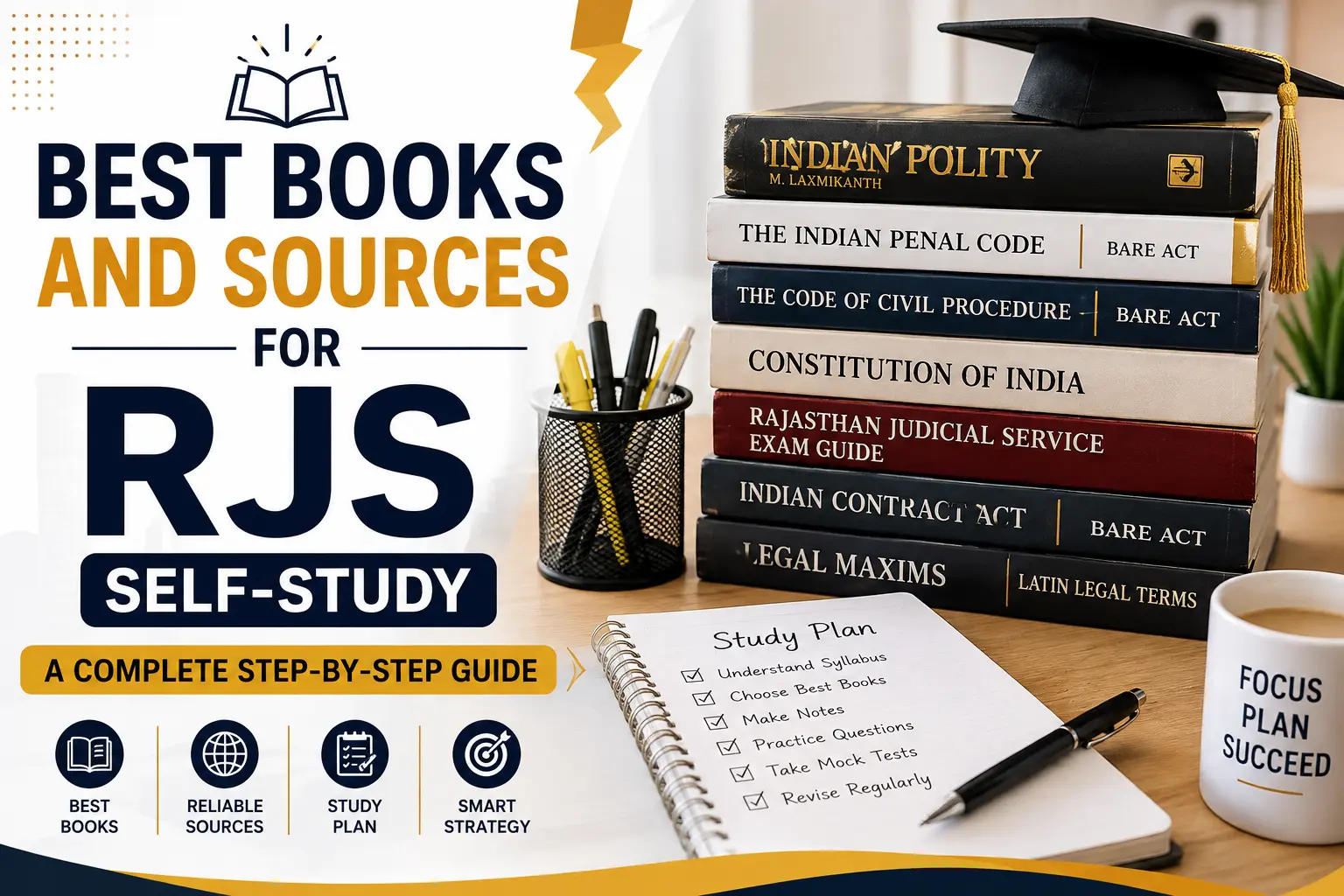
Best Books and Sources for RJS Self-Study: A Complete Step-by-Step Guide
If you’re preparing for the Rajasthan Judicial Service exam on your own, without a coaching institute holding your hand through it, the book selection stage is where most people either set themselves up well or waste months chasing the wrong material. RJS is genuinely doable through self-study. Plenty of judicial officers sitting on Rajasthan’s benches today prepared exactly this way, sitting at home with a stack of bare acts and a study plan they built themselves. But self-study only works if you’re reading the right things, not the most things.
This guide walks through exactly which books and sources actually matter for RJS Prelims, Mains, and the interview, section by section, so you’re not left guessing which of the fifteen recommendations floating around online are worth your time.
Why Book Selection Matters More in RJS Than in Most Exams
RJS isn’t testing how much you’ve read. It’s testing whether you can apply the law precisely—quote the right section, cite the right provision, and structure a judgement the way a judge actually would. That changes how you should be choosing books.
A commentary that explains a concept beautifully but never gets you close to the bare act’s actual language won’t help you in Mains, where examiners expect exact sections and precise wording. On the flip side, reading bare acts without any explanatory book leaves you with definitions but no understanding of how those provisions actually get applied to facts. You need both, but in the right proportion—one solid reference book per subject, paired with consistent bare-act reading, beats five books skimmed superficially almost every time.
Step 1: Start With the Exam Pattern, Not the Book List
Before opening a single book, get the current RJS syllabus and exam pattern in front of you. RJS runs in three stages—preliminary (objective), mains (subjective, both a language paper in Hindi and English and two law papers in civil law and criminal), and an interview. Prelims is purely qualifying, while Mains marks actually count toward your final merit along with the interview.
Knowing this changes your book strategy right away. For Prelims, you need breadth and speed—quick-reference books and practice sets. For Mains, you need depth—books that help you write structured, well-reasoned answers with correct citations. Don’t prepare for both stages with the same set of books; the skills being tested are different enough that your material should be too.
Step 2: Build Your Bare Acts Collection First
This is the one step self-study aspirants skip most often, and it costs them later. Bare acts are the actual legal text as passed by the legislature—no interpretation, no simplification, just the law itself. A huge chunk of RJS Prelims questions are lifted almost directly from statutory provisions, and Mains answers are graded partly on whether you can quote the right section number.
Here’s an important update if you’re prepping for RJS in 2026: criminal law in India shifted from the old codes to the new ones back in July 2024. That means the Indian Penal Code, the Code of Criminal Procedure, and the Indian Evidence Act are no longer your primary study texts—they’re reference material now, useful mainly for understanding what changed and why. Your actual primary texts should be
- Bharatiya Nyaya Sanhita (BNS) — replacing the IPC
- Bharatiya Nagarik Suraksha Sanhita (BNSS)—replacing the CrPC
- Bharatiya Sakshya Adhiniyam (BSA)—replacing the Evidence Act
If any book or coaching material you’re using still treats IPC and CrPC as the core criminal law texts without properly integrating BNS, BNSS, and BSA, that material is outdated and worth dropping.
Beyond criminal law, keep these bare acts within arm’s reach through your entire prep: the Constitution of India, the Code of Civil Procedure, the Indian Contract Act, the Transfer of Property Act, the Specific Relief Act, the Limitation Act, and Rajasthan-specific statutes like the Rajasthan Rent Control Act and the Rajasthan Court Fees and Suits Valuation Act.
Step 3: Pick One Reference Book Per Subject
Once your bare acts are sorted, add exactly one good reference book per subject to help with illustrations, landmark judgements, and the kind of analytical depth main questions demand. Resist the urge to buy three books for the same subject—it genuinely creates more confusion than clarity, and RJS toppers consistently mention sticking to a single trusted book per topic rather than juggling multiple sources.
| Subject | Recommended Book/Author | What It’s Good For |
| Constitution of India | M.P. Jain or D.D. Basu | Doctrines, fundamental rights, landmark judgements |
| Civil Procedure Code (CPC) | Takwani | Application-based understanding, judgement, and writing practice |
| Contract Act & Specific Relief Act | Avtar Singh | Clear explanation with case law integration |
| Criminal Law (BNS-based) | K.D. Gaur or Ratanlal & Dhirajlal (updated editions) | Illustrations, general exceptions, fact-based application |
| Family Law (Hindu & Muslim Law) | Paras Diwan | Covers both personal law systems with clarity |
| Limitation Act | Bare Act + a short guide | Practical application, limitation periods for suits |
| Current Affairs & General Knowledge | India Year Book, Lucent’s General Knowledge | Broad coverage for prelims and interviews |
Notice this table doesn’t list ten options per row. That’s deliberate—pick one from each row, read it two or three times over your prep cycle, and you’ll retain far more than someone who skimmed five different books once each.
Step 4: Get Serious About the Language Papers
RJS Mains includes both Hindi and English language papers, and a surprising number of aspirants under-prepare for these because they feel less “legal” than the law papers. That’s a mistake—language papers carry real weight in your final score.
For the essay component, the Compendium of Essays from Spectrum Publications works well for English essay structure and vocabulary, while Samanya Gyan Evam Nibandh from Lucent Publications is a solid choice for Hindi essay writing. Beyond books, build a daily habit of reading editorials—The Hindu for English and Rajasthan Patrika for Hindi and regional current affairs—since both feed directly into essay writing and general awareness sections.
A Quick Note on Legal Awareness and Reasoning
Legal Awareness and Legal Reasoning sections, which show up in Prelims especially, benefit from a dedicated book like Arihant’s Legal Awareness and Legal Reasoning guide, paired with regular practice of reasoning-based MCQs. This section rewards practice far more than raw reading, so don’t just read through it passively—actually sit and solve timed sets.
Step 5: Layer in Rajasthan-Specific Knowledge
This is the part general judiciary prep books often skip, and it’s exactly where self-study aspirants can lose easy marks if they’re not careful. RJS tests state-specific law and general knowledge that pan-India judiciary books simply don’t cover in depth.
Make sure your prep includes Rajasthan’s history, culture, and geography at a basic level, along with state-specific acts like the Rajasthan Rent Control Act and the Rajasthan Court Fees and Suits Valuation Act. A regional current affairs habit—following Rajasthan Patrika or a similar source regularly—pays off here too, since state-level developments show up more often than aspirants expect.
Step 6: Don’t Skip Previous Year Papers
Whatever books you choose, make solving previous years’ RJS question papers a non-negotiable part of your routine, not an afterthought squeezed in at the end. They tell you exactly how questions get framed, which sections examiners return to repeatedly, and where the actual difficulty lies compared to what a textbook might suggest.
Several publishers compile RJS previous year papers with solutions specifically, and working through these regularly does more for your time management and question sense than another round of reading theory ever will.
Step 7: Add Mock Tests to Your Routine
Books build your knowledge base, but mock tests are what convert that knowledge into exam performance. For prelims, timed MCQ mocks help you build speed and accuracy under pressure. For Mains, writing full-length answers within the actual time limit—not just planning what you’d write—is the only way to know if your pace actually works on exam day.
After every mock, go back and review it properly. Look at what you got wrong, what you guessed on, and where you burned too much time. This review step is where the real improvement happens—more than the mock attempt itself, honestly.
Common Mistakes Self-Study Aspirants Make
A few patterns show up again and again among candidates who struggle despite putting in real effort.
Buying too many books for the same subject is probably the most common one—six different CPC books don’t mean six times the understanding; it usually means confusion about which explanation to trust. Ignoring the shift to BNS, BNSS, and BSA is another costly mistake, since sticking with outdated IPC-centric material wastes preparation time on a code that’s no longer the primary text. Treating bare acts as optional reading rather than the foundation of your prep is a third comment. Commentaries help you understand the law, but bare acts are what let you quote it precisely, and that precision is exactly what main examiners look for.
And finally, underestimating the language papers and Rajasthan-specific content because they feel secondary to “real law” is a mistake that costs many aspirants marks they didn’t need to lose.
Putting It All Together
If you strip all this down to a simple sequence, it looks something like this: get your bare acts collection sorted first, especially the updated BNS, BNSS, and BSA for criminal law. Add one solid reference book per subject rather than several. Build a genuine daily habit around current affairs and editorials rather than cramming them later. Layer in Rajasthan-specific knowledge deliberately, since it doesn’t show up in generic prep material. Solve previous year papers regularly, and take mock tests seriously enough to actually review them afterward.
Self-study for RJS isn’t about reading everything available—it’s about reading the right things, consistently, and testing yourself against real exam conditions along the way. Get that combination right, and the book list stops being overwhelming and starts being just another part of a plan that’s actually working.
Frequently Asked Questions
Can RJS actually be cleared through self-study alone?
Yes, many aspirants have cleared RJS through self-study. It requires more discipline in building your own study plan and staying consistent, but it’s genuinely achievable with the right books and a structured routine.
Are bare acts really necessary, or can I rely on guidebooks alone?
Bare acts are essential, especially for prelims and for precise citation in mains. Guidebooks help you understand concepts, but bare acts give you the exact statutory language examiners expect you to know.
Should I still study IPC and CrPC, or only BNS and BNSS?
Focus your primary preparation on BNS, BNSS, and BSA, since these are now the operative laws. Keep IPC and CrPC as reference material to understand what changed, rather than as your main study texts.
How many books should I use per subject?
One well-chosen reference book per subject, paired with the bare act, is usually enough. Adding more books rarely adds proportional value and often just eats into your revision time.
Is language paper preparation really that important for RJS?
Yes. The Hindi and English language papers carry real weight in your Mains score, so they deserve dedicated preparation time rather than being treated as an afterthought.