
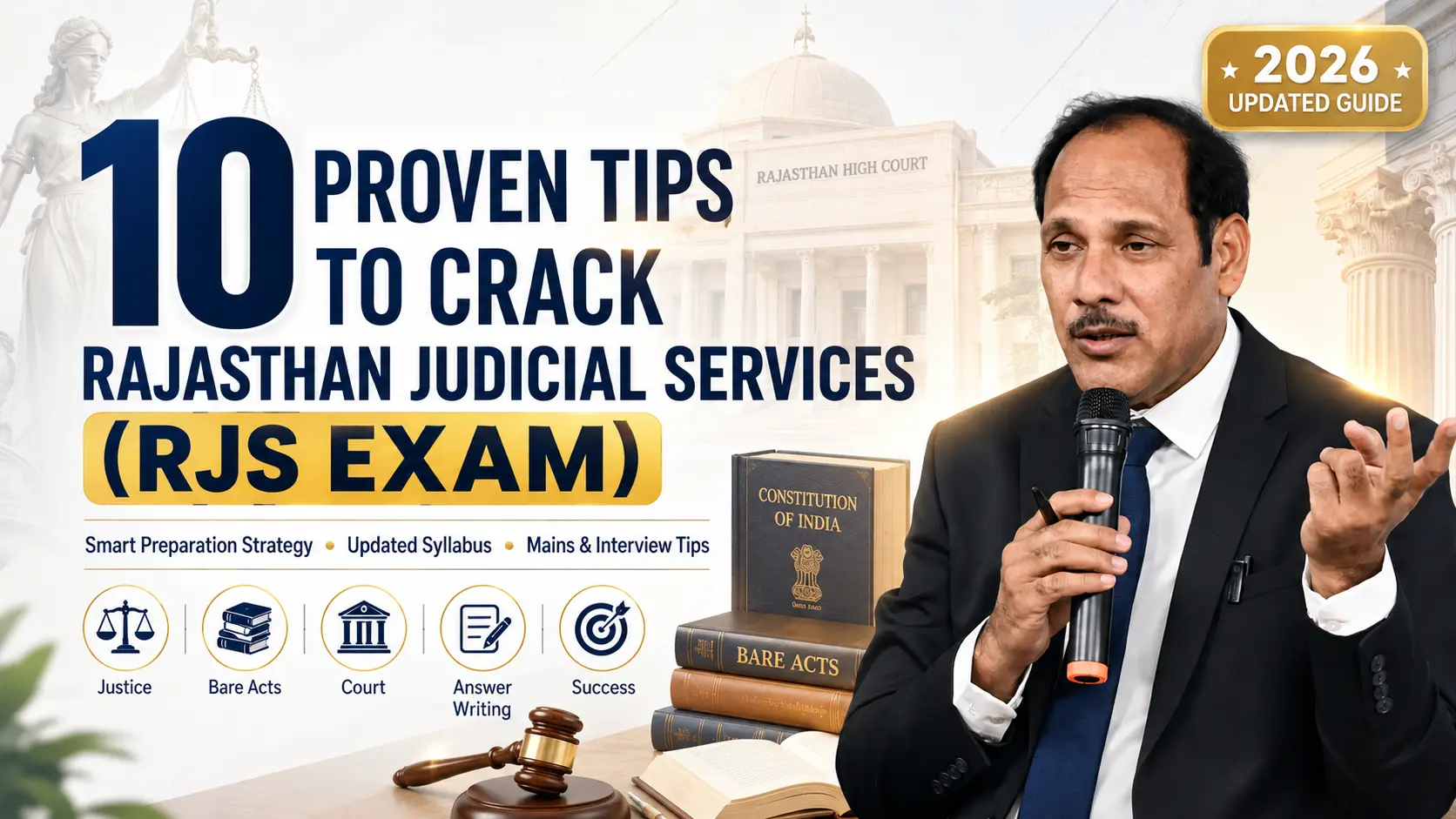
The Rajasthan Judicial Services (RJS) exam is one of the most competitive and prestigious exams for law graduates in India. Every year, a huge number of contenders strive for a handful of Civil Judge posts making the competition truly intense. The examination pattern continues to remain a three-tier process which includes preliminary examination (objective), mains examination (descriptive) and interview (viva-voce). With the recent introduction of new criminal laws in India- Bharatiya Nyaya Sanhita (BNS), Bharatiya Nagarik Suraksha Sanhita (BNSS) and Bharatiya Sakshya Adhiniyam (BSA) and a few other changes, preparing for the RJS is an even tougher task.
Passing the RJS exam requires more than just sheer study hours. One must be a smart student, have a thorough understanding of the law, and develop the attitude of a judgeship. Most aspirants collect notes and books year after year and still do not succeed because they study without a plan, whereas toppers focus more on concept-building, revision, answer writing, and mock tests.
In this article, you would find some vital tips for Rajasthan Judiciary Exam for every aspirant, be it a fresh law graduate or a re-examinee.
Understanding the Rajasthan Judicial Services (RJS) Examination
Before one start preparing for the Rajasthan judiciary exams, it is quite crucial to understand the exam. One can see RJS exam as construction of a building, which would collapse without a proper foundation and without it, all the effort will be wasted. Similarly, in a highly competitive, exam like RJS, having in-depth knowledge of the scheme and pattern of examination will only save time by avoiding unnecessary studying of irrelevant topics.
Current RJS selection process includes 3 stages:-
S. No. Stage Type Marks
1 Preliminary Examination Objective 100
2 Mains Examination Descriptive 300
3 Interview (Viva Voce) Personality Test 35
Preliminary examination is held just to screen candidates for the mains exam, and no special credit is given for clearing the preliminary examination in the mains selection merit list. As we know that the mains examinations consist of the highest weightage in the RJS exams; you should never only study just for preliminary examinations. You should prepare simultaneously in order to give proper weightage to both.
Know the Updated RJS Syllabus
One of the biggest andmost common mistakes that aspirants often commit while preparing for RJS exam is that they start preparing without reading the syllabus carefully. Imagine yourself beginning on a journey to somewhere unknown without knowing your destination-that is what you do by relying solely on coaching materials without studying the prescribed syllabus and notification carefully.
According to the recent syllabus, the syllabus include Civil Law, Criminal Law, Constitutional Law, Contract Law, Property law, Family law, Limitation Act, Specific Relief Act, Rajasthan specific Laws, English, Hindi, Current Affair and General Knowledge. In accordance with the recent notification a lot new laws have been added in the Rajasthan Judiciary Exam syllabus, they are the new criminal laws which include Bharatiya Nyaya Sanhita (BNS), Bharatiya Nagarik Suraksha Sanhita (BNSS) and Bharatiya Sakshya Adhiniyam (BSA), Information Technology Act, POCSO Act and several new Rajasthan specific acts as well. Aspirants are requested to compare the syllabus of the older examination with the existing syllabus and discontinue preparation of older materials because this information can be asked and is not included in the current study material.
Instead of reading material, which is available in abundant, make a checklist of all the acts and section that has been provided in the syllabus and tick mark your progress. This way will not make you stressed by all irrelevant materials.
Build a smart preparation strategy
Success in judiciary examinations hardly comes from excessive studying, consistency is always the key. One might find that studying 16 hours on one day and no studying on next three days is less beneficial compared to having a proper time-table and sticking to it.
The journey of RJS exam preparation must begin from Bar Acts. All judges preparing and preparing for judiciary exams lay emphasis on reading Bar Acts repeatedly as in the Bar Acts you get the exact language of the law. Textbooks can explain the concept of any section but Bar Acts will remain always first choice in judiciary exams for both pre and mains.
Here’s a sample schedule for the judiciary exam preparation-
Study Bare Acts daily
Study one major topic of the syllabus
Solve MCQ on objectivity at the end of the day
Write one descriptive answer
Read current legal affairs daily
Revise the topics already studied.
It is also important to revise on a weekly basis since most candidates studying judiciary examine and judiciary aspirants through discussion consistently argue that if one studies, there should also be continuous revision and mock tests. Many judiciary aspirants also suggest not referring too many texts, books and notes as this only leads to more confusion.
Subject-wise Preparation Tips
It is necessary to give different types of preparations for all the subjects-
In Civil Law, one should focus on the application and concepts rather than the sections and judgments (if it is a conceptual question). Always keep in mind landmark judgments and try writing descriptive answers in an analytical approach.
Criminal Law has become extremely important after the new criminal codes in the syllabus, hence candidates should prepare the differences between new laws and old laws as the questions in the criminal section can ask for it. They should also try creating comparative notes where possible.
In the constitution of India, one should take the importance of Fundamental rights, directive principles, amendment to the constitution,judicial review, landmark Supreme Court judgments and so on because it is the basic of Indian legal studies and is associated with almost every law.
Language sections i.e Hindi and English should be considered significant because not only an aspirant writes a better essay and an answer but it also plays a role in the interview as good speaking and writing skill enhance personality to a larger extent. Regularly read legal editorials, news papers etc and try writing essays so that to have perfection in language.
Master Answer writing for mains
Most of the aspirants clear the preliminary examination but unable to clear the mains examination because they have not developed answer writing skills. It is not necessary that we need to have great memory to recall legal provisions but you also need to have the application and analysis skill with the application of the law.
All answers should be written in a prescribed format-
– Brief introduction
– Relevant laws/ provision
– Landmark judgements (if any)
-Legal analysis and arguments
– Conclusion
Ensure that your answers are not too long and only relevant. Good handwriting if appearing in a offline examination is appreciated. Mentioning the Bar Act wherever required adds to the quality of your answer.
Importance of Mock Tests and Previous year question papers
The most important and valuable source for preparing for judiciary exams are the previous year papers since the papers not only include frequently asked questions or chapters but also the expected type of questions. Mock tests are also used to analyze where the preparation needs to be improved. You should ask yourself questions like why did I commit a mistake- Was it a concept error, or was it something that was forgotten, or was the reading of question was wrong and so on.
The questions in mocks should be critically analyzed and learned from it.
Around 10-20 full syllabus mock tests should be taken by aspirants before the exam, but also take note that solving more mock tests may also be detrimental sometimes. It is more important to have analyzed your mock test than solving extra mock tests.