CLAT vs RJS: Which One to Choose After 12th/Graduation?
Choosing a career in law can be confusing, especially when students come across terms like CLAT, RJS, judiciary exams, law entrance exams, and judicial services. One of the common questions that law aspirants ask is, CLAT vs RJS—which career path should you opt for after 12th or graduation?
The answer depends largely on your current qualification, career goals, interest in the legal profession and the type of work you want to do in the future.
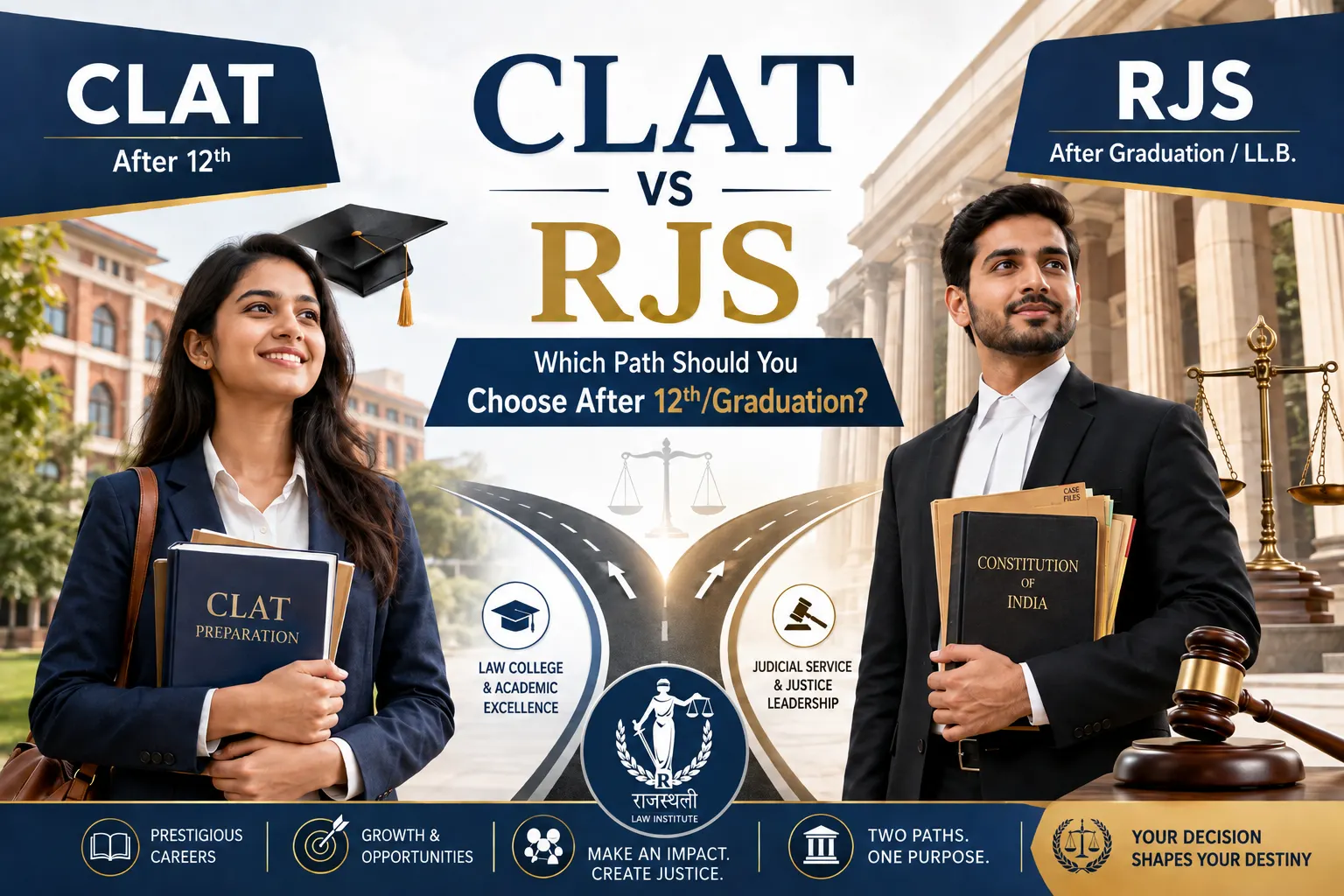
CLAT and RJS are related to law, but they are completely different. CLAT is mainly a law entrance test, and RJS is a recruitment test for judicial service for eligible law graduates.
In plain terms, CLAT can get you started in your legal education and RJS can get you on your way to a career in the Rajasthan judiciary once you’ve completed the necessary law qualification.
Rajasthali Law Institute brings to you this detailed guide to understand the major differences between CLAT and RJS, their eligibility stages, preparation styles, career opportunities and how students can choose the right path after Class 12 or graduation.
What is CLAT?
CLAT is the Common Law Admission Test. It is one of the largest national-level law entrance examinations in India. It is mainly used for admission to the participating National Law Universities and other institutions that consider CLAT scores.
Students of Class 12 who have passed or are appearing can apply for CLAT if they want to pursue an undergraduate law program.
Law degree students study different areas of law including Constitutional Law, Criminal Law, Contract Law, Family Law, Property Law, Administrative Law, Corporate Law and procedural subjects.
But students need to remember that clearing CLAT does not make one a lawyer or a judge directly. CLAT is an entrance examination that primarily helps students to start their formal legal education.
If you are a student looking for structured CLAT Coaching in Jaipur, then you need to work on your reading ability, reasoning skills, general awareness, time management, and regular mock-test practice.
Who Can Opt For CLAT?
CLAT can be a good option for students who should be in Class 11 or Class 12.
Have passed Class 12 and wish to study law.
Want admission to the participating National Law Universities.
Interested in litigation, corporate law, the judiciary, legal consultancy, or academics.
Reading, logical reasoning, current affairs, and problem solving.
Interested in a professional career in the legal field.
If you are looking for Best Law Coaching in Jaipur then you should opt for an institute which offers structured preparation, regular practice, doubt clearing, mock tests and proper academic guidance and not rely only on promotional claims.
What Is RJS?
RJS means the Rajasthan Judicial Service.
The Rajasthan Judicial Service examination is related to recruitment in the state judiciary of Rajasthan. This is a professional competitive exam for eligible law candidates who want to pursue a career in judicial services.
Unlike CLAT, RJS is not an entrance examination for admission to a law college or university.
It is a career-oriented examination for the candidates who have obtained the required legal qualification and fulfill the eligibility criteria as specified in the relevant official recruitment notification.
For RJS preparation one should have good knowledge of Legal Subjects, Bare Acts, Statutory Interpretation, Language Skills, Answer Writing, Procedural Laws and judicial aptitude.
Students seeking RJS coaching in Jaipur generally require a more law-focused preparation approach than those preparing for the CLAT.
Who is RJS meant for?
RJS may be a good fit for candidates who:
* Successfully obtained the required legal qualification.
* Aspirant for judicial service.
* Likes to study law in detail.
Strong analytical and writing skills.
Interest in public service.
* Able to follow a disciplined study schedule.
* Willing to study Bare Acts on a regular basis.
Desire to enhance reasoning and decision-making skills in judicial decisions.
If you are looking for the Best RJS Coaching in Jaipur, make sure that your preparation includes conceptual clarity, Bare Act study, previous year questions, mains answer writing, mock tests, revision, and interview guidance.
CLAT vs. RJS: Understand the Fundamental Difference
The most important thing to understand is that CLAT and RJS are not alternatives to each other at the same stage of your education.
Usually CLAT happens at the beginning of your legal career.
RJS is after you’ve done the required law qualification.
For example, a student of Class 12 cannot directly appear in RJS just because he wants to become a judge. The student must have first completed the required legal education and satisfied the applicable eligibility conditions.
Here’s a look at a possible career path:
Class 12 → CLAT or any other law entrance exam → Law Degree → RJS Preparation → Rajasthan Judicial Service Examination
CLAT is just one of many routes into legal education. Other universities may also admit students on the basis of their own entrance examinations or other recognized procedures.
So, students must understand that CLAT can be the beginning of their legal journey and RJS can be a career goal after completing graduation in law.
CLAT vs. RJS—Quick Comparison
| Factor | CLAT | RJS |
| Full Form | Common Law Admission Test | Rajasthan Judicial Service |
| Purpose | Admission to law programmes | Recruitment to judicial service |
| Career Stage | Beginning of legal education | Professional career stage |
| Suitable For | Mainly students after Class 12 | Eligible law graduates |
| Main Focus | Reading, reasoning and aptitude | Detailed legal knowledge |
| Study Style | Passage-based and aptitude-oriented | Bare Acts, law and answer writing |
| Career Outcome | Entry into law education | Judicial service after selection |
| Preparation | Reasoning, comprehension and mocks | Law subjects, writing and revision |
| Ideal Goal | Starting a legal career | Building a judicial career |
After Class 12: Which Stream to Choose?
If you have just passed class 12, then your first priority should be to decide whether you want to study law or not.
If you really want to be a lawyer, judge, legal consultant, corporate counsel, legal researcher, or another legal profession, getting a law degree can be an important first step.
At this stage, CLAT may be one of the examinations you may consider.
After 12th? If You Want to Study Law, Choose CLAT.
Think about CLAT if:
* You want to go for law after class 12.
* You have to apply to the participating National Law University.
You want to explore different legal careers.
* You like to do analytical reading.
* You are interested in the news.
You can answer questions under time pressure.
* You want to have good reasoning and understanding skills.
A good Law Coaching Institute Jaipur program for CLAT aspirants must assist the students in building the concepts gradually instead of just providing them with a lot of study material.
Also, regular mock tests and thorough analysis are important, as they help students to identify their weaknesses and improve their accuracy.
What Should You Choose After Graduation?
The answer to what you do depends on the type of degree you completed after graduation.
If you are a qualified law graduate and fulfill the eligibility conditions mentioned in the respective Rajasthan Judicial Service recruitment notification, then you can think of RJS preparation.
However, if you are graduating with a non-law subject, don’t think that you are automatically eligible for RJS. You would first have to do the required law qualification and fulfill the eligibility conditions as set out by the competent authority.
If your aim is judiciary, choose RJS after LL.B.
If your goal is a career in the judiciary, then RJS may be the right career path for you.
Preparation for judicial service means that candidates have developed:
Well-versed in corporate law.
Correct construction of statutory provisions.
Good ability to write good answers.
Analytical thinker
Job temperament for a judge.
Management of time.
Linguistic abilities.
Periodic review.
Students who are looking for Judiciary Coaching Jaipur must go for the preparation which focuses on conceptual learning and also practical requirements of Prelims, Mains and other stages mentioned in the applicable recruitment process.
RJS Preparation vs CLAT Preparation
Both exams require discipline and consistency, but methods of preparation are very different.
CLAT is more of an aptitude test, while RJS requires much deeper knowledge of law.
How to Prepare for CLAT
CLAT prep, in general, is all about improving:
* Understanding of Reading
Logical reasoning.
* Legal reasoning
* Current events.
*General knowledge.
* Quantitative methods;
Speed and accuracy.
* Managing time.
Students should practice passage-based questions and read regularly.
Mock tests play a very important part in CLAT preparation. But it is not enough just to take mock tests. Students need to go through each test to see why they got questions wrong and what they can do to improve.
Students appearing for law entrance examinations can focus on systematic approach of conceptual learning, practice, revision, and test analysis at Rajasthali Law Institute Jaipur.
How to Prepare for RJS
RJS preparation is more detailed and legal-oriented.
The candidates should prepare the subjects mentioned in the official syllabus for the relevant recruitment cycle.
Preparation can include:
*Regular reading of Bare Act.
Exposure to significant legal concepts.
* Amendment of statutory provisions.
Working through last year’s papers.
* Solving objective questions.
* Writing main answers in a descriptive way.
* Improving Hindi & English writing skills wherever relevant.
* Practice tests.
* Repeatedly revising the syllabus.
* Interview preparation when required.
For students looking for the best judiciary coaching in Jaipur, they should look for a place where equal importance is given to: understanding legal provisions, revision, answer writing, and examination strategy.
Job Opportunities After CLAT, the CLAT itself does not determine your final career.
It helps you get into legal education, and then you may have several career opportunities.
Lawsuits
Law graduates can enter litigation after fulfilling the requisite educational and professional prerequisites.
Litigation is suitable for students who enjoy legal research, writing, litigation, client interaction, and case analysis.
Business Law Law graduates work in business, law firms, consulting organizations, financial institutions, and start-ups. Corporate legal work can involve: *Agreements. * Regulatory compliance. Laws on employment. * M&A. Property, Intellectual. Governance (Corporate) Trade.
Courts
Students who are pursuing law in college and have an interest in judicial service can later prepare for exams like RJS after they satisfy the required eligibility conditions.
Legal Consulting
Law graduates can work as legal consultants or advisers for companies, institutions, NGOs, and organizations.
Students of Legal Research
Students who are interested in teaching and research may continue on to higher education and academic careers.
Government exams
Law graduates can also appear for many government and legal recruitment exams based on the eligibility criteria for the respective posts.
Hence, CLAT can be considered as the beginning of a legal career and not the end of it.
Career Opportunities After RJS
RJS is a much more focused career path.
Those who qualify in the concerned recruitment process shall be appointed in the Rajasthan judicial service as per the relevant rules and procedure of appointment.
Working in a career in the judiciary is a big responsibility.
Judicial officers must interpret laws, evaluate evidence, understand arguments, follow court procedures, and make impartial decisions.
A candidate for the judiciary as a career is to develop the following qualities:
* Honesty. * Integrity.
* Patience.
Nonpartisan.
* Self-discipline.
* Thorough knowledge of the law.
Analytical ability.
Good communication.
Sense of responsibility
The judiciary should not be selected on the basis of status or social recognition. Students should first know the nature of judicial work and responsibility.
Do you need CLAT to become a judge?
No, you do not.
And this is one of the biggest myths for students.
CLAT is not necessary to become a judge.
CLAT is essentially an entrance test for the participating law universities. There are other recognized methods of admission by which a candidate may obtain a recognized law qualification.
As far as RJS is concerned, it all boils down to whether the candidate meets the educational and other eligibility conditions as mentioned in the official rules and recruitment notification on the said issue.
Wherefore:
CLAT is useful to go to law school, but clearing CLAT is not needed for RJS.
Can You Prepare for RJS in Law School?
Yes. Students can start to lay a judiciary foundation during their law degree.
But the first step should be to understand legal concepts well rather than trying to remember the whole syllabus of RJS.
You can start by:
* Bare Act read.
* Legal terminology.
*Case studies Legal notes, short. Concepts of procedural law
answer writing
The last year’s Judiciary questions.
* Recent legal developments.
* Revision on a regular basis.
Start early. It’s easier to do serious prep after you’ve graduated.
Which is Tougher? CLAT vs RJS
CLAT and RJS are hard to compare directly, as they are at different stages of a legal career.
CLAT is a hard exam, as it tests your reading speed, reasoning, awareness, and ability to perform accurately under strict time limits.
“RJS is a tough nut to crack as candidates need to have deeper legal understanding, good memory, answer writing skills, Bare Act knowledge and disciplined preparation in multiple subjects.
So don’t ask what exam is harder; ask—
Which examination is applicable to my current stage?
CLAT can be relevant if you have cleared Class 12 and want to enter law.
If you are a law graduate and you are eligible and you want to join the Rajasthan judiciary, then RJS is relevant for you.
CLAT vs RJS: How to Choose the Right One?
Ask yourself these questions before you decide.
What Is Your Current Qualification?
Your immediate focus should be the law admission and legal education if you are in Class 12.
If you have already qualified as a lawyer, you may wish to consider judicial service preparation, subject to eligibility.
What Is Your Goal In Your Career?
If you want to practice in various fields of law, get a good legal education first.
If you are looking at judiciary specifically as your long-term goal, then you can prepare for RJS at the appropriate stage.
Would You Like to Know Law Better?
Preparing for RJS involves a lot of legal reading.
If you are very fond of statues, legal concepts, interpretation, and writing, then judiciary preparation may be for you.
Are You Ready To Prepare Consistently?
RJS as well as CLAT need discipline.
CLAT requires regular aptitude practice, while RJS requires deep legal study, revision, and answer writing.
Common Errors Students Must Steer Clear Of
Many aspirants take decisions regarding their career without proper understanding of the examinations.
Don’t make these mistakes:
Assuming CLAT and RJS are the same type of examination.
Assuming CLAT is a must to become a judge.
Starting RJS preparation without knowing eligibility.
Ignore Bare Acts.
Memorizing without understanding of legal concepts.
Necessarily dependent on coaching notes.
Skipping mock tests.
Do not refer to previous year papers.
studying without a revision plan
Picking a career because your friends are picking it.
Knowing exactly what you want can save you a lot of time and effort.
How Rajasthali Law Institute Supports CLAT & RJS Aspirants
A systematic approach to preparation can lead to better student outcomes.
Rajasthali Law Institute gives academic assistance to law entrance and judiciary exam preparation students.
For students looking for Rajasthali Law Institute Jaipur, CLAT Coaching in Jaipur , RJS Coaching in Jaipur, Judiciary Preparation, a study schedule including concepts, practice, tests, and revision can be followed.
A good coaching program should try to make students understand what to study, how to study, and how to find out weaknesses in preparation.
Whenever you are looking for the Best Law Coaching in Jaipur, Law Coaching Institute Jaipur, Best RJS Coaching in Jaipur, Judiciary Coaching Jaipur, or Best Judiciary Coaching in Jaipur, always look for factors like faculty support, study structure, answer writing practice, mock tests, and doubt clearing before your decision.
Final call on CLAT or RJS
So, CLAT vs. RJS—Which path to choose after 12th or graduation?
The answer depends on your current qualification and career goal
If you are a Class 12 student and want to pursue a career in law, first focus on getting into a suitable law program. It can be one of the major examinations you can think of for this purpose.
If you have done the required law degree and want to join Rajasthan judiciary, then you can think of preparing for RJS after carefully checking the latest eligibility criteria.
Most importantly, do not forget that CLAT and RJS are not necessarily competing career options.
For some students, they can be different points on the same journey:
12th → CLAT → Law Degree → RJS Preparation → Judicial Career
Your career in the law should be based on your interests, aptitude, qualifications, and long-term goals, not on trends.
Whether you start your CLAT preparation or later switch over to RJS preparation, consistency, proper guidance, regular practice, and disciplined revision will still be important.
Always check the detailed eligibility criteria, syllabus, examination pattern, important dates, and other requirements from the respective official authorities before applying for either examination.