
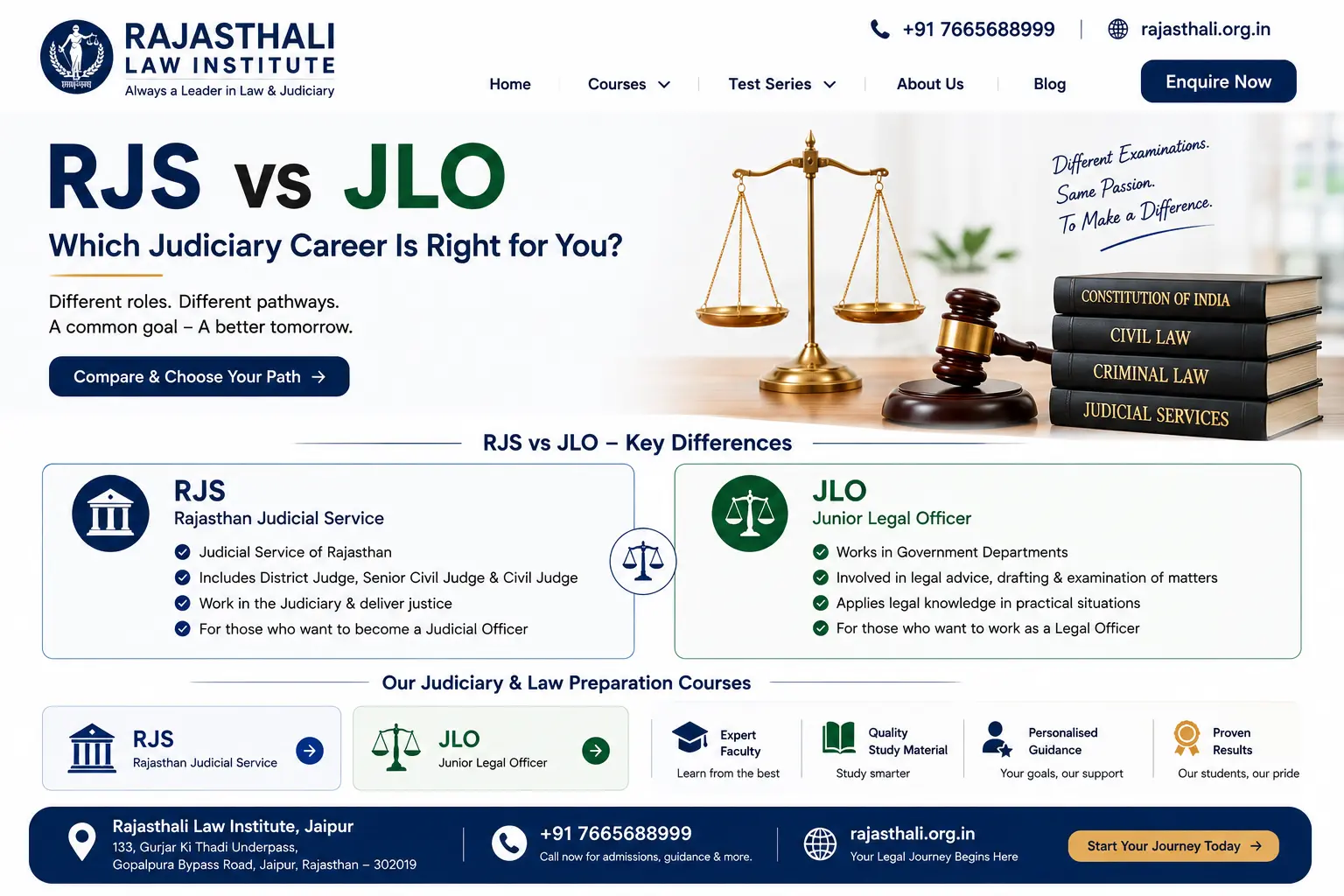
RJS or JLO—What Judicial Career Path Is Right For You?
Careers you can pursue after an LL.B. can be confusing. Law graduates have many options to explore, such as judiciary, legal services, prosecution, advocacy, and other legal positions in the government. The RJS and JLO are the popular competitive exams for law graduates.
All three relate to the legal field, but their job roles and career paths differ.
Law students can understand these differences and choose a career that aligns with their interests and goals.
What Is RJS?
RJS stands for Rajasthan Judicial Service. It is the judicial service path for aspirants who want to make a career as a judicial officer in Rajasthan.
The RJS examination comprises various stages like the preliminary examination, the main examination, and the interview as per the rules & notification applicable.
RJS aspirants need to have a good hold on law along with excellent writing, analytical, and communication skills.
RJS might be a good fit for you if:
• You are looking for a career in the judiciary.
• You have an interest in becoming a judicial officer.
• Laws are fun for you to learn and interpret.
• You are comfortable with legal reasoning and making decisions.
• You are seeking a long-term career in judicial service.
JLO – What Is It?
JLO means Junior Legal Officer. A JLO is a legal position that may engage in legal advice, legal issue review, drafting, and other duties depending on the department and relevant service rules.
If you’re a student interested in government legal work but not the judicial bench, JLO might be worth a look.
Rajasthali Law Institute offers JLO-focused preparation and has the following features—live classes, doubt sessions, study resources, mock tests, and practice support.
When JLO May Be Right for You:
• You want to do law work for the government.
• You like legal research and drafting.
• You want to become a legal officer.
• You want to work in a government organisation where you can apply your legal knowledge.
.
RJS vs JLO: The Key Difference
| Feature | RJS | JLO |
| Full Form | Rajasthan Judicial Service | Junior Legal Service |
| Main Career Area | Judiciary | Legal Service |
| Main Interest | Judicial Decision-Making | Government Legal Work |
| Suitable For | Student Aiming For Judicial Service | Students Interested in Legal Officer Role |
| Preparation Focus | Law, Legal Reasoning, Language, and Exam-Specific Preparation | Relevant Laws and Legal Knowledge |
| Career Direction | Judicial Service | Legal Officer |
Note: Eligibility, age limit, syllabus, vacancies, exam pattern, and recruitment rules are subject to change. Candidates are advised to refer to the latest official notification before applying for the same.
RJS or JLO: Which One Is Better for a Career?
There is no single answer to this question, as the best choice depends on your interest and career goal.
If you want to become a judicial officer, choose RJS.
If you want to be part of the judiciary and work as a judicial officer, RJS is the most relevant path to explore.
Select JLO If You Love Legal Officer Jobs
If you like legal research, drafting, legal advice, and government legal work, you might want to prepare for JLO opportunities.
How to Get Ready for These Exams?
RJS and JLO are different tests, but a solid foundation in law is essential for preparing for any serious law competitive exam.
Here are some effective preparation habits:
1. Know the Syllabus
Begin with the latest official syllabus and examination notification. List out all the subjects. Break them down into smaller topics.
2. Read the Bare Acts
Bare acts are an important part of law preparation. Read the relevant provisions carefully and try to grasp their practical meaning.
3. Previous year questions (practice)
Past papers are useful for getting a clear idea of the kind and standard of questions asked and for helping to identify areas for revision.
4. Practice Regularly
Regular practice of MCQs can help improve speed and accuracy, while regular writing in a descriptive style can help students prepare for exams, which include written answers.
5. Sample Tests
Mock tests can assist students in determining their level of readiness and where they need to do more practice.
6. Dispel your doubts.
In cases of dissolution, bankruptcy, or liquidation of a business, the following shall apply: Regular doubt solving will help in building stronger concepts and increasing confidence.
RJS AND JLO Rajasthan Law Institute
Rajasthali Law Institute, Jaipur, helps in the preparation of RJS, JLO, and other judiciary-related examinations. The institute has features like expert faculty, online test series, live and offline classes, one-to-one doubt sessions, evaluated tests, personalised guidance, and interview preparation.
The institute also provides online and offline learning facilities with preparation support in the English and Hindi mediums.
Students can choose their preparation based on their education and career goal.
How to Choose the Right Exam?
Before you select an exam, ask yourself:
• Is a career as a judicial officer for me?
• Am I more interested in government legal work?
• Do I like criminal law and prosecution?
• What subjects do I enjoy studying?
• What kind of legal career do I want to have in the future?
• Which exam is suitable for my eligibility? When you know your goal first, you can be more focused on your preparation.
Final Thoughts
RJS AND JLO can give law graduates many options for a career. RJS is for judicial service, and JLO is for prosecution legal officer posts.
Don’t choose an exam just because it’s popular; instead, get to know the role, eligibility, examination requirements, and career path before you choose.
Consistent study, strong legal concepts, regular practice, and proper guidance can help law graduates prepare more confidently for their chosen examination.
Begin your journey with the right career goal and the right preparation strategy.
FAQs
What is the distinction between RJS AND JLO?
RJS is related to judicial service. JLO is a legal officer career that is related to prosecution.
LL.B. Can graduates prepare for JLO and RJS?
Eligibility is determined by the respective examination and the latest notification. Candidates are advised to read the official recruitment rules before applying.
3. Do you need coaching for these exams?
Coaching is not mandatory, but structured classes, test series, doubt sessions, study material, and personalised guidance can help students prepare in a more organised manner.
RJS vs JLO: What Kind of Judiciary Career is Right for You?
Careers you can pursue after an LL.B. can be perplexing. Law graduates have a plethora of career options, including judiciary, legal services, prosecution, advocacy, and other government legal jobs.
RJS and JLO are options for law graduates. These exams lead to different types of legal careers, so it is important to know what each entails before choosing your preparation path.
In this guide, we will explain the differences between RJS and JLO, their career paths, preparation requirements, and how to choose the right option for you.
What is RJS?
RJS is the Rajasthan judicial service.
RJS is the Rajasthan Judicial Service. The Rajasthan Judicial Service Rules, 1998, lay down that the service shall be the cadre of District Judge and the cadre of Senior Civil Judge and Civil Judge.
RJS is a crucial exam for students aiming for a career in the judiciary.
The RJS preparation needs profound knowledge of law, continuous revision, legal reasoning, practice of answer writing and preparation as per the latest exam pattern.
RJS May Be The Right Fit For You If:
• You desire to make a career in the judiciary.
• You would like to work in the judiciary.
• You enjoy studying and learning laws.
• You possess good analytical and decision-making skills.
• You are comfortable with legal writing and reasoning.
• You aspire to a career as a judicial officer.
What Is JLO?
JLO means Junior Legal Officer.
A junior legal officer is a legal post and may be involved in legal advice, drafting, interpretation of laws, and other legal duties depending on department and service rules laid down.
The Rajasthan Public Service Commission has announced recruitment for the post of Junior Legal Officer. The official notification and exam updates are available on its recruitment portal.
If JLO might be right for you,
• You are interested in working in government law.
• Like legal research and writing.
• You want to use your knowledge of law in a government job.
• You need legal advice and interpretation.
• You prefer a career in legal practice rather than as a judicial officer.
RJS vs. JLO: Differences
Feature RJS JLO
Full Form: RJS Junior Legal Officer
Primary Career Area: Judiciary & Legal Services
Primary focus: judicial service Government legal work
Suitable for students aspiring to become judicial officers Students aspiring to become legal officers
Key interests: legal research, drafting, legal adviceLaw, legal reasoning and judicial work
Career Path: Legal Officer, Judicial Officer
NOTE: Eligibility, age limit, syllabus, vacancies, and selection procedures are subject to change. Candidates are advised to refer to the latest official notification before applying.
JLO or RJS—which is better?
There is no single best test for every law graduate.
The best choice will depend on your career goals, interests, and strengths.
Choose RJS if you are interested in the judiciary.
If you want to work in the judicial system and aim to become a judicial officer, RJS is probably the most relevant option to explore.
You should be comfortable with such things as legal concepts, legal reasoning, legal writing, and close reading.
If you like government legal work, choose JLO. JLO could be a particularly suitable place for students interested in legal research, drafting, interpretation, and government legal responsibilities.
If you like working with legal documents and applying laws to real-life issues, this career path
Before Deciding on an Exam, What Should You Think About
Before you decide on RJS OR JLO preparation, ask yourself a few simple questions:
1. What kind of law work do I like?
Think about whether you’d like to do judicial work, legal officer work, or prosecution.
2. What do I like to learn?
If you have an interest in criminal law, this field may be a good fit for you. If you are interested in broader legal concepts and judicial reasoning, RJS may be a better fit for you.
3. What are my strengths?
Think about your strengths in:
•Legal reasoning
• Writing
• Law of crime
• Research legal
• Communications
• Analyses
• Case study
4. What does the recent notification say?
Never choose an examination purely on past data. Always refer to the latest official notification for eligibility, syllabus, age criteria, and selection process.
How to Prepare for RJS AND JLO?
These are three entirely unique career paths, but a strong knowledge of law is important for all of them.
1. Understand the syllabus.
Start with the latest official syllabus. List subjects. Divide the subject into smaller topics.
This makes managing your preparation easier.
2. Read the Bare Acts
Bare acts should form an important part of your law preparation.
Don’t just try to memorise the sections. Concentrate on the meaning of the provisions and how they are applied.
3. Practice Previous Year Papers
Previous year question papers will help you understand the types of questions asked and identify important areas.
Try to solve them in a time frame.
4. Practice MCQs
Regular practice of MCQs helps improve speed and accuracy, especially in objective examinations.
5. Respond with better legal drafting
If your exam has descriptive papers, practise writing answers that are clear and well-structured. You will need the following:
- Understanding of question The relevant legal provisions are quoted below: • Write your answer in a neat way
- Justify your answer with relevant legal reasoning
- Time management
- Practice Tests
These practice tests will help you to assess your level of preparation and areas where you need to improve. Regular testing also helps in confidence and time management in exams. 7. Revise regularly. There are many subjects and rules in law to keep in mind. So regular revision is important. Do not read one subject and forget about it. Revise it at regular intervals.
Rajasthali Law Institute of RJS AND JLO
Rajasthali Law Institute, Jaipur. Preparation for RJS AND JLO, other judiciary-related examinations Its current website offers expert faculty, personalised guidance, live and offline classes, online test series, one-to-one doubt sessions, evaluated Mains tests, interview guidance, and exam-notification support. The institute provides online and offline learning modes in English and Hindi, offering preparation support for the Prelims, Mains, and Interview stages.
Preparation Key Features
Feature: How it helps learners
Live classes offer interactive learning.
Classroom-Based Preparation: Offline Classes
Online classes give flexible learning.
The Prelims Test Series Enhances MCQ Practice
The main test series helps in developing Answer writing skills
Evaluated Answer Sheets Helps to identify mistakes
Doubt Sessions: Individual academic support
Study material helps with learning and revision.
Interview guidance helps you prepare for the last leg.
Exam Updates Help Students to Keep Track of Important Notifications
With personalised guidance, students can stay on track by following a focused study plan.
Rajasthali’s current website also lists the RJS Target, RJS Till Selection Target programmes, and degree-plus-RJS alternatives.
So why begin judiciary prep early?
Early preparation allows students to become familiar with the legal concepts and to develop effective study habits.
Law students can begin to slowly:
• Bare Acts Reading
• MCQs solving
• Practice previous year papers
• Practice in legal writing
• Summary of major issues
• Major legal developments following
• Mock test taking
The aim is not to learn it all in a short span of time. Sometimes long hours of study are not as important as regular preparation.
Conclusion
RJS and JLO are different career options for law students, and each has its own focus area.
RJS stands for judicial service, and JLO stands for legal officer roles with prosecution.
Know the job role and check the latest official eligibility criteria before selecting an examination. Think about the kind of legal career you want.
Strong legal concepts will help you prepare for your chosen examination in a more organised way through regular practice, mock tests, revision, and proper guidance.
Frequently Asked Question
- What is the difference between RJS and JLO?
RJS is a judicial service, and JLO is a legal officer career related to the prosecution and criminal justice system.
2. Which is better, RJS or JLO?
It really depends on your career goal. RJS is better for students interested in the judicial service, while JLO is better for those interested in government legal work.
3. Yes, you can prepare both RJS and JLO together.
Some legal subjects may overlap, but each exam has its own syllabus and requirements. It is important to go through the specific syllabus and pattern of the exam you are planning to appear in.
4. Is Rajasthali Law Institute providing RJS AND JLO coaching?
Yes, Rajasthali Law Institute has listed RJS as a JLO as one of the judiciary-orientated prep offerings.
5. Does Rajasthali offer online and offline classes?
Yes. Now the institute claims to provide online and offline classes with preparation support in the English and Hindi mediums.