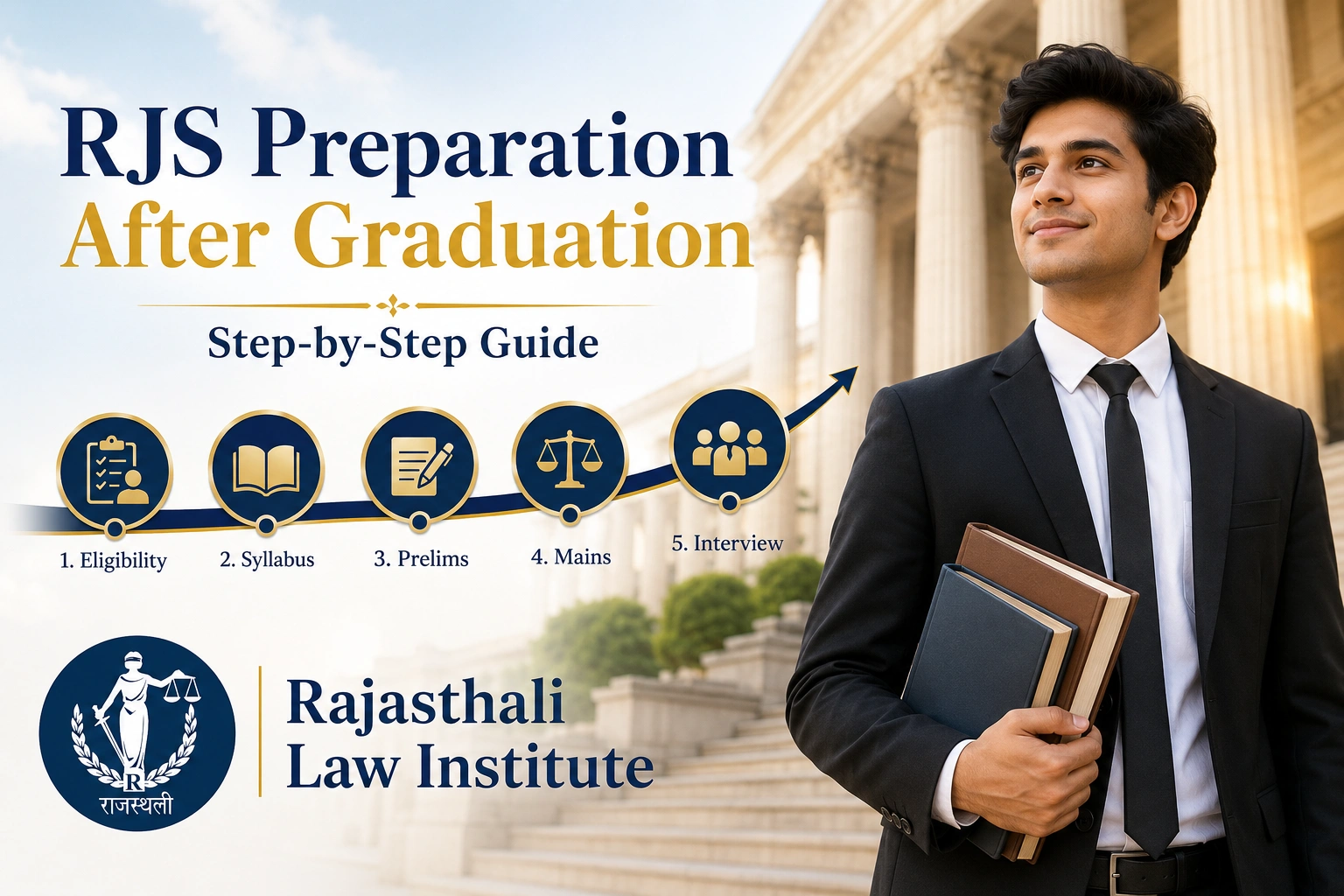
RJS Preparation After Graduation: Step-by-Step Guide
Introduction
RJS Preparation After Graduation allows an aspirant to organise the complete syllabus around one career goal. It is the right stage to turn classroom knowledge into a structured routine of bare-act reading, problem-solving, revision, and written practice.
Candidates generally need an eligible LL.B. degree and must satisfy the applicable notification. Final-year students need to make sure they are allowed to apply and find out when they need to show their qualification.
This guide was checked on August 10, 2026, from the Rajasthan High Court Civil Judge recruitment page; it’s a recent 2025 advertisement and the Rajasthan Judicial Service Rules, 2010. Eligibility, syllabus, and examination patterns may change, so always double-check with the official website.
Understanding the RJS Examination
What Is the Rajasthan Judicial Service Examination?
It offers law graduates a chance to enter judicial service and to handle trial court matters with fairness and legal responsibility.
Selection Process of RJS
The process normally has three stages:
- Preliminary Examination: Objective assessment of legal knowledge, memory and language skills.
- Main Examination: Legal analysis, application, writing and language ability are assessed in the descriptive mode.
- Interview: Suitability screening, communication, awareness, temperament and knowledge related to Rajasthan.
These stages call for integrated preparation. The prelims exam requires you to be fast and accurate. On the other hand, the main exam and the interview are different. They need you to have an understanding of the subjects, be able to express yourself well and have a balanced way of judging things.
Step 1: Look at the rules to be eligible for RJS.
Qualification Education
For the job posted in 2025, you need an LL.B. degree from a university that is allowed by law in India and is recognised under the Advocates Act, 1961. This is what the 2025 ad said. The RJS Eligibility Criteria says you must have this degree.
It allowed final-year or final-semester candidates to apply subject to acquiring and proving the qualification within the notified period. The next recruitment cycle may have different requirements.
Age. Relaxation
Check the minimum age and maximum age, calculation date and category relaxations in the current advertisement. Eligibility under a notice does not guarantee eligibility under a later one.
Candidates claiming a relaxation should also confirm the certificate format, issuing authority, validity period and document submission deadline.
Language and Other Requirements
The latest advertisement requires knowledge of Hindi, in Devanagari, and knowledge of Rajasthani dialects and social customs. It also states nationality and other service conditions.
Read the notification and amended rules together instead of relying on old posts, videos, summaries, or social media screenshots. The two main law syllabi, along with Hindi and English proficiency.
Step 2: Understand the Latest RJS Syllabus
Prelims Syllabus
In 2025, Prelims was objective and drew its law component from the two Mains law syllabi, along with Hindi and English proficiency.
To make things simpler, you should break down your syllabus checklist into these parts:
- Civil laws
- Criminal laws
- Minor and special laws
- Rajasthan-specific laws
- You should also separate the languages:
- Hindi and English
- And do not forget to include current legal developments.
This way it is easier to see what you have completed, what you need to practise and what you need to revise for laws. Criminal laws, minor and special laws Rajasthan-specific laws and current legal developments, in both Hindi and English.
Mains Syllabus
The Mains Syllabus needs you to really understand the laws and rules. You have to know about laws and criminal laws. The Mains Syllabus also includes laws, personal laws and special laws. You have to learn how to write orders, charges and judgements.
Look at the papers to see how much you need to know about each subject. Do not spend the amount of time on every chapter. Some chapters are bigger and harder than others. Some chapters are also more important for the exam. The main syllabus is very detailed. The main syllabus requires a lot of studying.
Important: the 2025 syllabus names both the new and older criminal-law frameworks:
- The Bharatiya Nyaya Sanhita of 2023. The Indian Penal Code of 1860.
- The Bharatiya Nagarik Suraksha Sanhita of 2023. The Code of Criminal Procedure of 1973.
- The Bharatiya Sakshya Adhiniyam of 2023. The Indian Evidence Act of 1872.
Prepare comparison charts. Follow the exact next message because this combination may change.
Language Papers and Interview Requirements
The 2025 Mains syllabus says we have to write essays in Hindi and English. For the Prelims we need to be good at language topics. We should practise grammar and vocabulary. Also work on making sentences and writing essays.
We can get better at languages by doing translation and summary exercises. This helps us to use language in a way. We should note that these exercises are not separate papers unless the syllabus says they are. For the interview we need to know what is happening in the world and about Rajasthan. We should also be able to talk.
Step 3: Collect the Right Study Material
First we need to get the updated bare acts for every law that’s applicable. Add one dependable textbook for difficult concepts, concise class notes, Rajasthan local-law material, current legal-affairs resources, and official Civil Judge previous-year papers.
Online lectures and offline classes are useful when they explain—not replace—the statutory text.
Avoid building a library you cannot revise. For one subject, a bare act, one conceptual source, personal notes, and practice questions are usually more useful than five competing books.
You need to make sure every edition is up to date with the changes and it follows the criminal law rules that are mentioned in the notice.
Step 4: Build Strong Legal Fundamentals
How to Read Bare Acts
When you read these acts, do it step by step. First you need to understand what the act is about, what it covers, what the important words mean and how it is divided into chapters. Then you need to read the parts that actually make the law along with any conditions, explanations, examples, exceptions and related sections.
You should ask yourself these questions:
- Who is allowed to use or apply the law?
- What are the requirements that must be met?
- What are the steps you need to take?
- Are there any exceptions?
- What legal consequence follows?
For example, connect a provision on temporary injunction with its conditions, procedure, remedy, and leading case-law principle. Mark important words, then close the book and explain the rule in your own language.
Prepare Personal Revision Notes
Create one-page summaries, limitation charts, provision maps, and case-law lists containing only the principle and its relevance.
Use comparison tables for BNS–IPC, BNSS–CrPC, and BSA–Evidence Act changes. Personal notes should become shorter with every revision instead of growing into another textbook.
Step 5: Create a Realistic RJS Study Plan
Daily Study Schedule
A full-time law graduate may follow this sample routine:
- 90 minutes: Bare Act reading and active recall
- Two hours: Conceptual study of one major or minor law
- 60 minutes: Revision of a previously completed topic
- 60 minutes: MCQs or previous-year questions
- 90 minutes: Main answer writing or language practice
- 30 minutes: Current legal developments and planning
This is only a model. Use shorter study blocks if needed and reduce the hours sensibly if you work or attend college.
Weekly and Monthly Goals
Set measurable goals, e.g., “Revise the definitions and selected chapters of one act, solve 250 reviewed MCQs and write four timed answers.”
Hold one weekly revision session and one test-analysis session. At the end of every month, assess:
- Coverage of syllabus
- Precision and recall
- Quality of answer-writing
- Results of tests
- Incomplete subjects
- Language enhancement
- Shift weak areas to next month before adding new resources.
Step 6: Get Ready for RJS Prelims
Read the relevant provisions and try concept-based MCQs. If you get it wrong, tell me exactly where you went wrong and why it was wrong.
It could be due to poor knowledge, confusion with similar rules, not reading the question carefully enough, or lack of time.
Try solving old papers on a timer and then move on to mixed mock tests. Generate a section for topic recall. Read each option thoroughly. Use elimination only if it is logically warranted.
Don’t get into the habit of guessing based on an old marking scheme. The rules applicable will be the ones of the next notification. And remember, analysis of mock tests is more important than solving a large number of tests.
Step 7: Start RJS Mains Answer Writing Early
Do not wait for the prelims result. Understanding a doctrine does not guarantee that you can produce a well-reasoned answer within the available time.
Begin with two answers every week. Gradually add problem questions, essay orders, charges and judgement-writing exercises mentioned in the syllabus.
Structure of a Good Legal Answer
A strong legal answer normally includes:
- The provision and legal issue.
- The governing. Principle in clear language.
- An important judgement where it genuinely supports the point.
- Application of the rule to the given facts.
- A brief and reasoned conclusion.
For a problem question, identify the dispute, state the rule and apply its conditions to the facts and conclude without inventing additional facts.
Improve Hindi and English Writing
Write one Hindi or English essay every week. Review its structure, grammar, transitions, repetition and conclusion.
Keep a notebook of legal vocabulary and commonly misspelt words. Use translations and occasional précis exercises to improve language skills.
However, exam-specific practice must follow the notified syllabus. Under the 2025 scheme, the main language papers were not separate translation or précis papers.
Step 8: Revise Through Previous-Year Papers and Mock Tests
Previous-year papers reveal recurring subjects, question language and the expected depth of preparation. However, they do not guarantee that the same questions will appear again.
Follow this four-step process after every test:
- Classify each mistake.
- Find the governing provision.
- Write the rule in one sentence.
- Schedule revision after one day, one week and one month.
- Maintain records for legal errors, language mistakes and time-management problems.
Step 9: Get ready for the RJS interview
Preparation for an interview should include legal concepts, the latest legal developments, knowledge about Rajasthan and current public issues.
Practise answering calmly, without it sounding rehearsed. Situational questions may assess impartiality, patience, ethics, empathy, procedural fairness and judicial temperament.
If you do not know an answer, acknowledge it honestly, or guess. Your communication should demonstrate balance, maturity and respect—not aggression.
Step 10: Avoid Common RJS Preparation Mistakes
The common mistakes include:
- Ignoring Bare Acts
- Studying without a timetable
- Using study material
- Delaying answer-writing practice
- Taking mock tests without analysing mistakes
- Neglecting Hindi and English
- Following many teachers or resources
- Changing books repeatedly
- Failing to revise regularly
Use one resource plan for several weeks before judging it. Update your material after checking an official amendment or notification.
A simple cycle of learn, practise, test, analyse, and revise is more reliable than looking for a new RJS preparation strategy.
Suggested Timeline for RJS Preparation After Graduation
Months 1–3: Foundation Building
Map the syllabus, limit your resources and develop a bare act-reading habit. Cover civil and criminal subjects while beginning language practice and short notes.
Months 4–6: Syllabus Completion and Practice
Complete the Rajasthan-specific laws. Increase MCQs, previous-paper practice answer writing and monthly revision.
Prepare comparison notes for the old criminal laws if both are included in your applicable syllabus.
Months 7–9: Prelims and Mains Preparation
Attempt mixed tests, timed papers, judgement-writing exercises and weekly essays. In addition to your usual practice, check your error log for subjects and correct them.
Final Stage: Review, Mock Tests & Interview Preparation
Reduce the reading and concentrate on revision, full-length mocks, short notes and time management. Increase the intensity of your interview preparation as you move through the written stages.
Modify each phase according to your knowledge and the official exam schedule.
How Does Rajasthali Law Institute Support RJS Aspirants?
Rajasthali Law Institute Jaipur provides guidance, structured classes, current study material and concentrated Bare Act explanations to support students in preparation for the RJS exam.
Its preparatory framework includes prelims practice, mains answer writing feedback, mock tests, interview preparation and individual mentoring.
Students seeking RJS coaching in Jaipur should judge any programme—including one described as the judiciary coaching in Jaipur—by syllabus accuracy, faculty access, feedback, revision support and consistency rather than guarantees.
Rajasthali Law Institute provides a framework while students remain responsible for disciplined daily work.
Frequently Asked Questions (FAQs)
Can I start RJS preparation immediately after completing my LL.B.?
Yes. Graduation is a time to begin structured preparation. First confirm your qualification and every other condition in the applicable official notification.
How long does RJS preparation usually take after graduation?
There is no duration. The time is a matter of your foundation, your hours of writing ability and the official examination schedule. The proposed timeline is flexible.
Is coaching required for RJS preparation?
No. Self-study can work, with resources and discipline. Coaching can provide structure, doubt-solving, test practice, feedback and accountability.
Should I prepare for Prelims and Mains together?
Yes. Study provisions and concepts together and then practise both MCQs and written answers. Closer to each stage, change the proportion of practice of completely abandoning the other format.
How many hours should an RJS aspirant study each day?
There is no number. A full-time aspirant may manage focused hours while a working candidate may have fewer. Track completed targets, recall and test improvement—not time spent studying.
Conclusion
RJS preparation after graduation becomes manageable when it is built around the syllabus daily: bare act reading, early answer writing, mock-test analysis and repeated revision.
Progress may feel slow initially. Consistent effort creates the accuracy and maturity that judicial examinations demand. Aspirants who want an RJS preparation strategy can approach Rajasthali Law Institute for guidance while keeping official notifications at the centre of every decision.