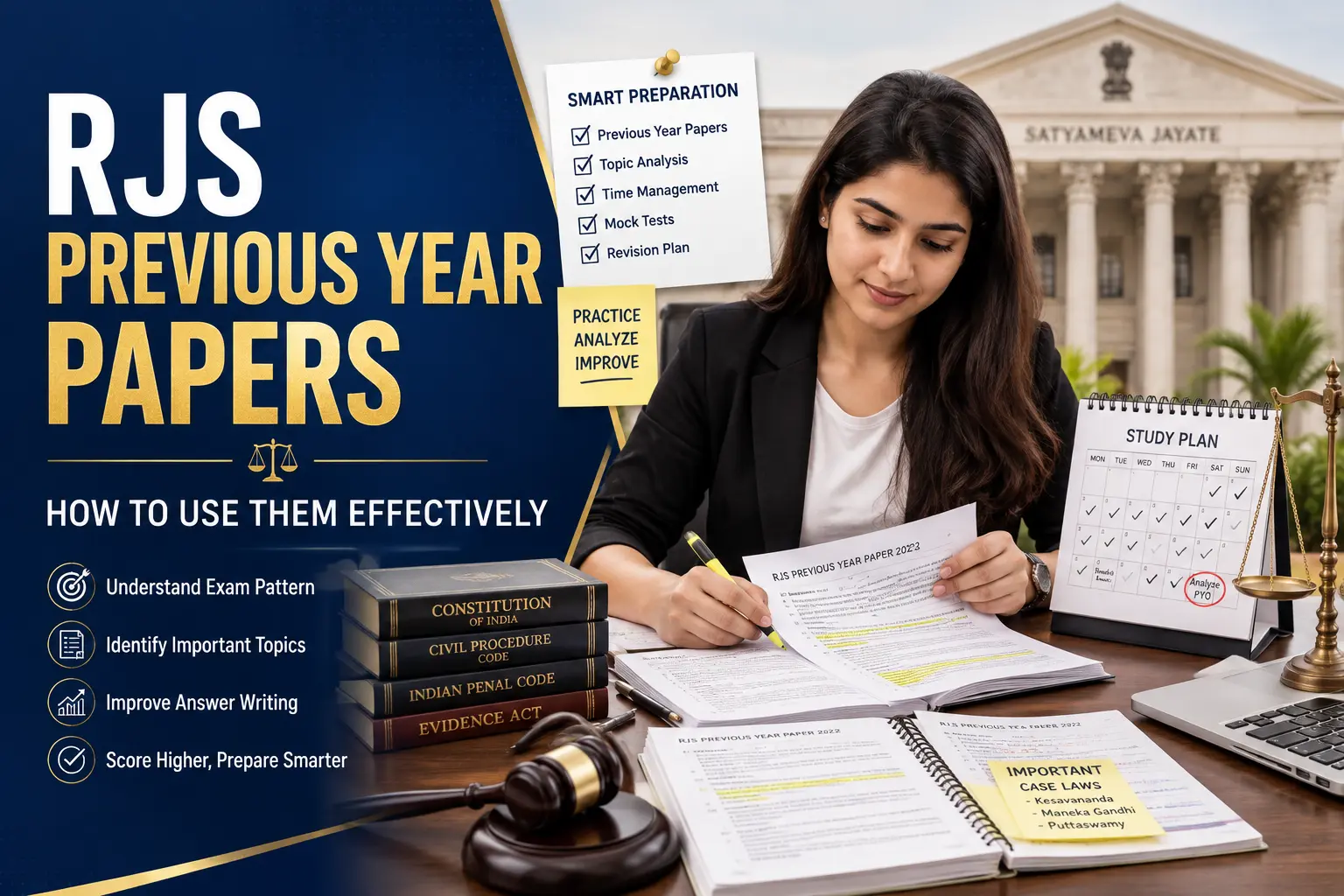
RJS Previous Year Papers: How to Use Them Effectively
Preparing for the Rajasthan Judicial Service (RJS) exam isn’t just about reading bare acts, memorising legal concepts, or putting in long hours with a stack of books. Smart preparation matters just as much as hard work — and one of the most genuinely useful tools a judiciary aspirant has is the set of RJS previous year papers.
These old question papers show you what the exam actually expects from you — the kind of questions asked, the areas tested again and again, the difficulty level, and how questions are worded in both prelims and mains.
The problem is, most students don’t use them properly. Some collect PDFs of ten years’ papers and barely open them. Others wait until a few weeks before the exam to start. A good number just checks the answer key without asking *why* an answer is correct.
Previous year papers only become valuable once you actually sit down and analyse them properly. Used right, they can sharpen your subject knowledge, accuracy, revision plan, answer-writing, time management, and confidence too. This article walks through how to actually use RJS previous-year papers throughout your preparation, not just at the end.
Why Previous Year Papers Matter So Much
The RJS syllabus is huge, and it’s easy to feel unsure about where to put your energy. Here’s the simplest way to think about it: the syllabus tells you what to study; previous year papers tell you how that syllabus gets tested.
Say you’ve read an entire bare act, cover to cover. Go through previous questions on it, and you’ll often notice certain definitions, exceptions, or procedural provisions come up far more often than others – something the bare act alone won’t tell you.
Previous papers help you spot:
– Legal concepts that get tested again and again
– Provisions and topics examiners clearly favour
– Recurring question patterns
– How deep your conceptual understanding actually needs to go
– Mistakes students commonly make
– What Prelims questions tend to look like
– What’s expected from a Mains answer
– Roughly how much time a full paper takes
In short, they make your preparation practical instead of purely theoretical.
Start Using Them Early — Don’t Wait
A mistake a lot of aspirants make is holding off on previous papers until the entire syllabus is done. You don’t need to wait that long — previous years’ questions should enter your preparation from day one.
Say you’re studying the Code of Civil Procedure. Once you finish an important chapter, check what RJS has asked on that topic before, and try answering those questions before looking at the solutions.
A cycle that works well:
Study the topic → read the bare act → attempt previous year questions → go through your mistakes → revise again
This tells you, honestly, whether you’ve actually learned something or just read about it. And if you’re getting things wrong, you find out immediately — not three months later when it’s too late to fix.
Practise Subject-Wise Before Full Papers
Early on, it’s far more useful to solve previous questions subject by subject rather than jumping into full-length papers every time. Group them by subject—Constitutional Law, CPC, Criminal Law, Law of Evidence, Contract Law, Transfer of Property, Family Law, Rajasthan Local Laws, Hindi, and English. Once you finish a subject or chapter, solve the related questions right away.
Why This Helps
Subject-wise practice gives you an immediate reality check. You might feel confident after reading a chapter twice, but the real test is whether you can answer exam-level questions on it. Still getting things wrong afterwards? That’s your sign to revise again.
It also stops passive learning. Instead of asking, “Have I read this chapter?”, ask, “Can I actually solve exam-level questions from it?” That’s a far more honest measure of where you stand.
Spot the Repeated Topics and Priority Areas
Go through enough previous papers and you’ll notice certain concepts coming back year after year. That doesn’t mean the exact same question repeats — the same area often gets tested from a different angle: one year a straight definition, the next year the same provision through an exception.
So pay attention to repeated *concepts*, not repeated *questions*. Keep a small notebook, sorting topics into rough categories — high priority, medium priority, and regular revision.
That said, don’t write off a topic just because it hasn’t shown up before — the examiner can pick from anywhere in the syllabus. Previous papers should guide your priorities, not shrink your syllabus.
Pair Bare Act Reading With Previous-Year Questions
Bare acts are one of the most important resources in judiciary preparation. Whenever you solve a previous year’s question, go straight to the relevant provision afterward. If you got it wrong, don’t just memorise the correct option — open the bare act and read the section carefully: the main provision, any proviso, explanations, exceptions, illustrations, and connected sections.
This matters enormously for objective questions. Sometimes the only thing separating two options is a single word or a small exception — and if your bare-act reading isn’t sharp, these questions will trip you up every time.
Understand *Why* an Answer Is Correct
Don’t stop at “Option C is correct”. Push further and figure out why C is right and why the others aren’t. This is what builds real conceptual clarity — and it pays off later, because even if the examiner rephrases the same principle differently, you’ll still work out the right answer instead of drawing a blank.
Using Previous Year Papers for Prelims
RJS Prelims demand strong recall, precision, solid legal understanding, and a good sense of timing. Previous papers can build all four.
Early on, don’t obsess over speed — focus on understanding first. Once you’re more confident, start timing yourself on full papers. After every attempt, go through your wrong answers and ask: Did I simply not know this? Did I forget the exact section? Did I mix up two similar provisions? Did I overlook an exception? Did I misread the question? Was it a careless slip, or did I get it right by guessing?
This kind of honest review teaches you far more than your raw score ever will. A poor score during practice isn’t a bad thing if it exposes a weakness before the real exam does.
Using Previous Year Papers for Mains
Mains is a different game. Knowing the law isn’t enough — you also have to present it clearly and within a tight time limit. Pick a previous Mains question and attempt it cold, without peeking at your notes first.
The best answer to a legal question will normally include a short introduction, the legal provision, an explanation of the principle underpinning the provision, the main conditions or exceptions, application to the facts if relevant, relevant case law if it assists the answer and a clear conclusion.
Don’t be tempted to pad your answer out with extra information just to make it longer. Judiciary answers are rewarded for being relevant and well-structured, not for length.
Practise Under Real-Time Pressure
Plenty of students know the law inside out but still can’t finish the paper on time, usually because they haven’t practised under real exam conditions enough. Give yourself a fixed time limit per question while practising. Over time, you’ll get a real feel for how much to write and how to pace an entire paper.
Keep a Mistake Notebook
This might be the single most underrated tool in RJS preparation. Every time you slip up on something important, note it down — briefly. Worth logging: sections you keep confusing, exceptions you tend to forget, tricky definitions, procedural differences, and recurring mistakes in your Mains answers.
You don’t need to copy the whole question — just the mistake and the fix. For example: Mistake: Mixed up two similar procedural provisions. Fix: Revise both side by side and note a one-line difference. With the final revision, this notebook becomes gold — a record of exactly where you personally go wrong.
Keep Track of Your Progress
Maintain a simple log of every paper you attempt — score, accuracy, time taken, weak subjects, and major mistakes. Don’t judge yourself off a single test; what matters is whether you’re improving across attempts: better accuracy, fewer careless errors, faster completion, and cleaner main answers. Steady improvement matters far more than one great or one terrible score.
Attempt Important Papers More Than Once
There’s no rule against solving the same previous year paper twice. After a gap of a few weeks, go back and attempt an important paper again. This shows you whether you’ve actually fixed your earlier mistakes. Just be careful not to memorise the answers themselves — the point of a second attempt is to test understanding, not memory of which letter you picked last time.
Use Previous Papers as a Revision Tool
Previous year questions aren’t just for initial learning — they’re excellent during revision too. After revising a subject, go solve related previous questions. Good accuracy? Move on. Weak performance? That tells you exactly which chapters need another pass. This turns revision into something measurable rather than a vague feeling of “I’ve gone through this already.”
Attempt Full Papers Under Exam-Like Conditions
Once most of the syllabus is behind you, start solving full-length papers in conditions that mirror the real exam – a proper desk, a timer, a phone put away, and no peeking at answers mid-paper. This builds concentration, stamina, speed, and genuine exam-day confidence. Afterward, spend real time analysing the paper — one paper reviewed properly teaches you more than five attempted and forgotten ones.
Don’t Rely on Previous Papers Alone
As valuable as they are, previous year papers shouldn’t be your only source of preparation. The examiner isn’t restricted to what’s been asked before. A well-rounded plan still needs bare acts, standard reference material, class notes, mock tests, regular answer-writing practice, and consistent revision alongside previous-year papers.
Think of previous papers as a compass, not a map. They show you how the exam has tested the syllabus before — they can’t tell you exactly what’s coming next.
Common Mistakes Students Make
Solving without analysing — checking your score isn’t enough; review every mistake that matters. Memorising answers instead of understanding them – don’t lock in an option without knowing the reasoning. Starting too late** — don’t save all your previous papers for the final month. Ignoring lucky guesses — if you guessed right, still verify the actual provision. Focusing only on repeated topics — they’re important but can’t replace covering the full syllabus.
A Simple Weekly Routine
Monday to Friday: study new topics, read bare acts, and revise as you go. Saturday: Solve subject-wise previous questions from whatever you covered that week. Sunday: Go through your mistakes, revise the weak provisions, and update your mistake notebook. Once most of the syllabus is done, start slotting in full-length previous papers regularly.
Why Good Guidance Helps
Previous year papers become far more useful when someone helps you understand why a particular question matters. Experienced guidance can point out key areas, clarify similar provisions, and sharpen your Mains answer-writing.
At Rajasthali Law Institute, RJS preparation brings together conceptual study, bare-act reading, previous-year paper practice, mock tests, and regular revision – working together rather than in isolation. The goal was never to solve the largest number of questions but to learn something from every paper.
Conclusion
RJS’s previous year papers are far more than old exam sheets sitting in a folder. Used properly, they make your preparation more organised, more focused, and more exam-ready — sharpening your bare-act knowledge, accuracy, mains practice, and time management along the way.
The one non-negotiable is analysis. Every time you get something wrong, dig into why, go back to the law, revise the concept properly, and make sure that mistake doesn’t happen twice. Start early, pair previous papers with your daily study, keep a mistake notebook running, and practise under a timer.
The point was never to predict next year’s paper. It’s to prepare yourself well enough that whatever question shows up, you’re ready to handle it with confidence.