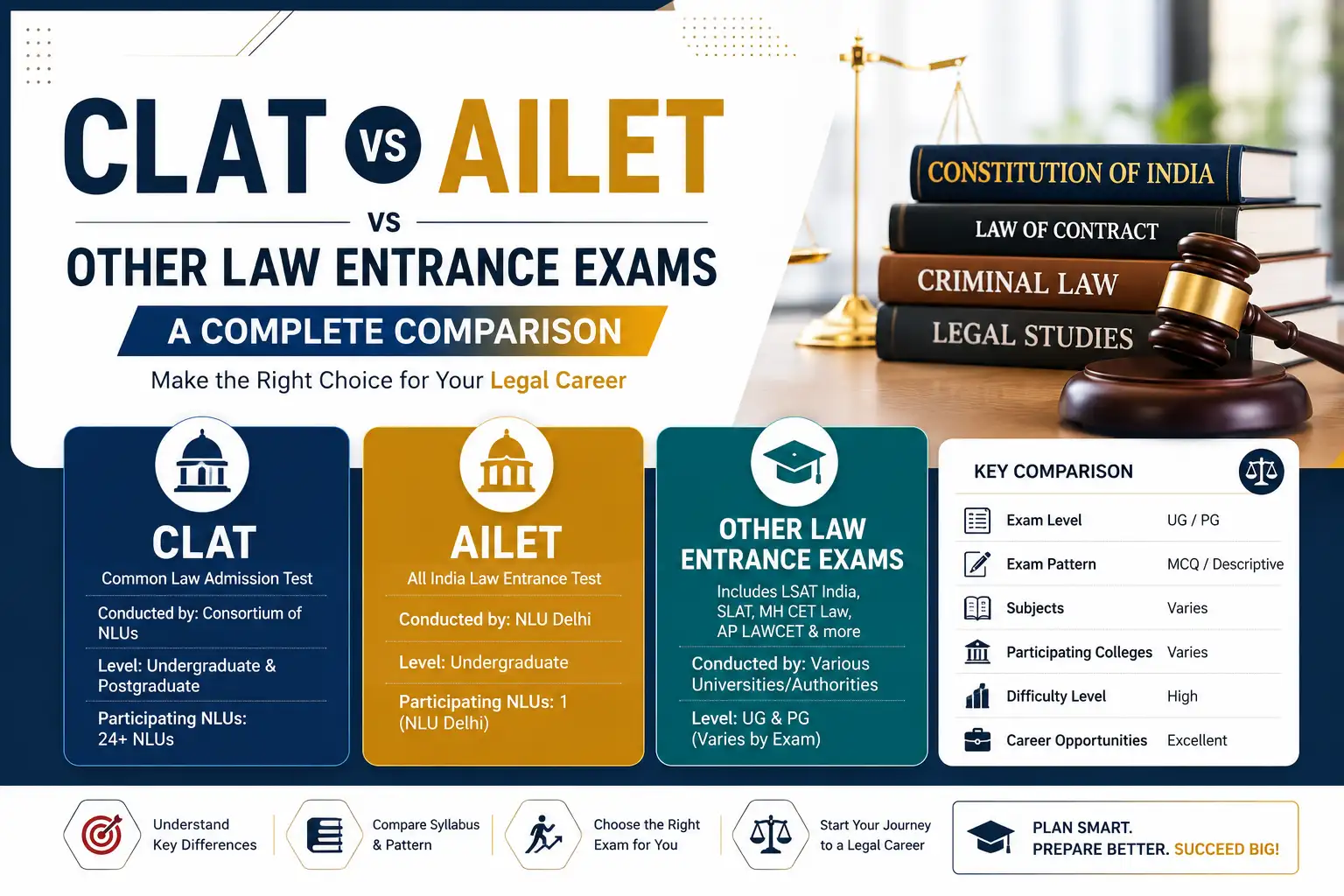
CLAT vs AILET vs Other Law Entrance Exams: A Complete Comparison
Somewhere around Class 12, if law’s even a little on your mind, this question shows up sooner or later: which entrance exam do I actually prepare for? Most conversations jump straight to CLAT vs. AILET because those two names get thrown around the most; everyone’s heard of them by then. But that’s not the whole picture, not even close. There’s a decent spread of university and state-level exams too, each running on its own eligibility rules, syllabus, and admission process, and a lot of students genuinely don’t hear about these until they’re already knee-deep in CLAT prep, which honestly is a bit of a shame when you think about it.
So how do you pick, then?
Comes down to a mix of things really. Your target college. How much time’s left on the clock. Where you’re okay studying. What kind of legal career you’re picturing eventually, even if that picture’s still fuzzy. This piece walks through CLAT, AILET, and a few other options worth knowing about, so you’re not figuring this out at the last minute like a lot of people end up doing.
Law entrance exams, at the core, are just competitive tests colleges use to shortlist students for their law programs, undergrad and postgrad both. Coming straight out of Class 12, they’re usually your way into BA LLB, BBA LLB, BCom LLB, BSc LLB, and a few other integrated five-year programs. Here’s something worth remembering early on—don’t apply everywhere and sort it out later; figure out first which exams your shortlisted colleges actually accept, then work backward from there. In India the names you’ll keep running into are CLAT, AILET, SLAT, MHCET Law, and then a long tail of university-specific tests nobody really talks about much until suddenly they matter a lot to somebody.
CLAT vs. AILET, quickly
Both are national-level, both genuinely hard to crack, but not aiming at the same thing at all, really.
CLAT, the Common Law Admission Test, gets you into the participating National Law Universities. Plural—that’s the important word there, worth underlining almost. It’s basically what people mean by “law entrance exam” anywhere in India; that’s just how the term gets used casually.
AILET, the All India Law Entrance Test, has one job. Getting you into NLU Delhi. That’s genuinely it, nothing else attached to it, no wider ambition.
Hold onto that difference. It shapes basically everything else in this piece.
| Feature | CLAT | AILET | Other Law Entrance Exams |
| Full Form | Common Law Admission Test | All India Law Entrance Test | Varies by exam |
| Main Purpose | Admission to participating NLUs | Admission to NLU Delhi | Admission to respective universities |
| Level | National | National | University/State/National |
| UG Course | Integrated 5-year law programs | Integrated 5-year law program | Depends on institution |
| Competition | Very high | Very high | Varies |
| English | Important section | Important section | Depends on the exam |
| Current Affairs | Important | Important | Varies |
| Logical Reasoning | Important | Important | Usually included |
| Legal Reasoning | Important | Important | Depends on the exam |
| Quantitative Techniques | Included | Included | Varies |
| Best For | Students eyeing multiple NLUs | Students set on NLU Delhi | Students targeting a specific university |
One thing before moving on, though. Patterns, eligibility, even which colleges participate—all of it can shift year to year, sometimes without much warning at all. Don’t build a whole strategy around some old notification found while scrolling late at night. Go check the current one instead; it takes maybe five minutes and saves a good deal of confusion later on.
Why’s CLAT come up in basically every single conversation about law entrance exams, though? That’s a fair question. Ask around, and it’s usually the first name out of anyone’s mouth, and that’s not just hype talking either; there’s substance behind it. It opens the door to the participating NLUs, and a handful of other institutions accept CLAT scores as well on top of that. The real draw, stripped down, is reach—score a decent rank, and you’ve suddenly got a shot at seats across several well-known law schools at once, not just the one. Matters a lot when you’re eighteen and genuinely unsure which specific college you’ll actually end up liking once you’re there.
There’s a quieter upside too, which doesn’t come up as often. The prep itself changes how you think, not just what you happen to know. Reading comprehension sharpens gradually. Current affairs stop feeling like homework and start feeling like something you actually want to follow. Reasoning speeds up. None of that vanishes once exam day’s over; it sticks around, shaping how you argue things out and think through problems generally, well past the exam hall itself, into college and beyond really.
If your goal’s any NLU, or honestly anywhere that takes CLAT scores, this is probably your exam. Works especially well if betting everything on one specific college feels risky and you’d rather keep a few doors open at once.
AILET’s the other big national-level exam here, built entirely around one target, NLU Delhi. If that’s where you want to end up, this exam stops being optional pretty quick.
NLU Delhi’s reputation keeps AILET seats brutally competitive every year, and honestly that part hasn’t shifted much at all. Something that surprises a fair few students, though—CLAT prep genuinely helps with AILET too, quite a bit actually. English, current affairs, logical reasoning, general awareness, quant, and analytical thinking—a good chunk overlaps between the two. That said, don’t go treating them like the same exam wearing two different names, because they’re not. Structure differs. How marks get distributed differs. The admission process itself isn’t identical either, not in some pretty meaningful ways.
If NLU Delhi’s the dream, build prep specifically around AILET rather than treating it as some CLAT side quest tacked on. And if a wider net across several NLUs is more the goal, prepping for both at once isn’t unreasonable, as long as eligibility’s met for each one obviously.
So Which One’s Actually Better
No clean winner here, honestly, and anyone claiming otherwise is probably trying to sell a course package of some kind.
CLAT gives more doors if several NLUs are on the radar at once. AILET has to sit at the center of the plan if NLU Delhi specifically is the landing spot.
Better question than “Which is better?” though—which exam gets you closer to the college you actually want? That reframe alone saves a surprising amount of wasted stress, more than most people expect walking in.
Go CLAT if the participating NLUs broadly are the target, multiple options through one exam sound appealing, reading-heavy prep doesn’t scare you off, and choices staying broad matter more than narrowing down early.
Go AILET if NLU Delhi specifically is the target; a genuinely tough exam doesn’t put you off, and prep staying tightly focused beats spreading thin across too many things.
Or do both, if eligible, and the target list has colleges under CLAT plus NLU Delhi. Syllabus overlap being what it is, one common prep track early on works fine, splitting off into exam-specific prep once dates get closer.
CLAT and AILET aren’t the only doors into law school, though, not even close, and plenty of students genuinely don’t realize how many other options exist until they’re already deep into CLAT prep with tunnel vision on.
SLAT, the Symbiosis Law Admission Test, is the route into Symbiosis’s law programs specifically. If a Symbiosis college is on the list, this one actually matters directly. Generally covers logical reasoning, legal reasoning, analytical reasoning, reading comprehension, and general knowledge, though checking the latest notification instead of trusting some old syllabus floating around is always smarter.
MHCET Law, the Maharashtra Common Entrance Test for Law, matters if Maharashtra colleges specifically are what’s being chased. Before sinking real time in, look up current eligibility rules, domicile requirements, and which colleges are actually participating this particular year; these details move around more than most expect.
Then there’s the whole category of university-specific entrance exams. Plenty of institutions just run their own tests or their own selection process entirely, separate from any national exam out there. So if a particular university is already in mind, don’t just assume it falls under CLAT or AILET automatically; check their official admissions page directly to see whether an entrance exam is even needed, which program is on offer, eligibility, syllabus, application dates, and how counselling plays out there specifically.
| Exam | Main Target | Level | Suitable For |
| CLAT | Participating NLUs | National | Students targeting multiple NLUs |
| AILET | NLU Delhi | National | Students targeting NLU Delhi |
| SLAT | Symbiosis law schools | University group | Students targeting Symbiosis |
| MHCET Law | Participating Maharashtra colleges | State | Students targeting Maharashtra colleges |
| University-specific exams | Individual institutions | University | Students targeting one specific university |
Point was never chasing whichever exam has the loudest name attached. It’s finding the one that actually leads to the college being chased, plain and simple, really.
Is any of these actually “easy,” though? That question comes up constantly, and there’s genuinely no fixed answer no matter how many times it’s asked. Difficulties are personal, more than most people admit to themselves honestly. What feels manageable to one person might trip up their closest friend completely, and the reverse holds just as often. Comes down to reading speed, vocabulary, how consistent current affairs prep’s actually been, reasoning ability, accuracy once the clock’s running low, and just how many mocks got genuinely sat through versus how many got promised. Chasing the “easy” exam rarely pays off in the end, not really. Better to put that energy into figuring out which exams actually lead somewhere worth going.
Getting the Prep Right
Good news first, a lot of these exams test overlapping fundamentals, so building six completely separate prep plans from scratch isn’t really necessary. One solid foundation, tweaked per exam later, works fine for most.
Start with the exam pattern itself. Pull the latest official syllabus, not some old prep book handed down from an older sibling or something half-remembered off a forum thread from years back. Formats change more often than expected; prepping off outdated info just burns time that’s genuinely in short supply already.
Reading matters more than people usually credit it for, honestly. Newspapers, editorials, legal news, that kind of thing—read to actually follow the argument being made rather than just skim for keywords to memorize later. That difference shows up eventually in comprehension scores even when it doesn’t feel like much in the moment.
Current affairs works best as a daily habit rather than some three-week scramble right before the date. Keep it simple. Short notes on national and international events, legal or constitutional changes, government policy, appointments, awards, and major sporting events. Nothing elaborate needed, just something actually stuck with over months rather than days.
Reasoning gets better with repetition, plain and simple, with no real shortcut around that one. Start slow, get the logic right first, then start timing once that’s solid. Speed without accuracy doesn’t help much, and accuracy without speed doesn’t either; both matter eventually, so build toward that rather than picking one over the other early.
Don’t skip quant just because it feels intimidating at first glance. Back to basics, consistent practice, and further getting there than someone jumping straight into hard problems without a real foundation underneath.
Take mocks seriously, the reviewing part especially, not just the taking part, because that’s genuinely where most students drop the ball. After each one, actually sit and look through what got wrong, what got guessed on, where too much time got burnt, and which topics keep tripping things up over and over. That review’s where most real improvement happens, more than the mock attempt itself honestly ever does.
Picking the Right Exam
Start with an honest list of colleges genuinely worth attending, not the ones that just sound impressive to mention around family. Check which exam each one accepts. Confirm eligibility criteria are actually met; don’t assume last year’s rules still hold. Compare exam patterns themselves, sections, marking schemes, duration, and question style; all of it matters here. Be honest about where actual strengths lie; if reading and reasoning come naturally, exams built around those feel less like a constant fight. And if more than one exam lines up with target colleges and eligibility is met for all, there’s no real downside to appearing for more than one; more attempts usually just mean more chances at landing somewhere good.
A handful of mistakes show up again and again, nearly every year without fail. Prepping without a clear target college wastes months; serious effort ends up going toward an exam that might not even matter to actual goals in the end. Pushing current affairs to the last few weeks almost always backfires, genuinely not something that crams well no matter how much convincing happens otherwise. Solving hundreds of questions without reviewing them teaches surprisingly little; the review’s where actual learning happens, not the solving itself. Following too many resources at once, ten books and fifteen channels and endless PDFs stacked up, usually just creates noise rather than real clarity. And ignoring time management trips up a lot of otherwise well-prepared students; knowing the right answer means nothing if getting there within the time limit doesn’t happen, so practice against the clock and not just for correctness alone.
Where This Leaves You
For a five-year integrated law course right after Class 12, CLAT, AILET, and the rest each open a slightly different door. CLAT works well for a wide net across participating NLUs. AILET matters most if NLU Delhi specifically is the goal. SLAT, MHCET Law, and various university-specific exams fill in the remaining gaps depending on region and preference.
A smarter approach was never picking an exam first and hoping it works out somehow. It’s deciding target colleges, then working backward to figure out exactly which exams actually need sitting for.
One more thing worth holding onto: the exam itself is just the starting line, not the finish. What actually shapes a legal career comes after—academics, internships, practical exposure gone out and got, and skills genuinely built along the way. No single test decides any of that, no matter how massive it feels right now in the middle of it all.
So instead of asking which exam’s the best, maybe ask which one gives the best shot at the law school actually wanted. That small shift in framing tends to make the whole preparation process feel a fair bit less overwhelming than it does right now.
Frequently Asked Questions
Is CLAT harder than AILET?
Both are genuinely tough; difficulty shifts year to year depending on how that particular paper’s set is. Rather than comparing in the abstract, focus on studying the current pattern for whichever exam’s actually being sat for.
Can I prepare for CLAT and AILET at the same time?
Yes, plenty of students do exactly that. Skill overlap’s real. Just make sure each exam’s specific structure and requirements get studied separately as dates get closer, instead of treating them as one and the same.
Which one’s actually better?
Neither, really. CLAT suits students aiming broadly at participating NLUs. AILET’s the one that matters if NLU Delhi specifically is the target.
Are there law entrance exams besides these two?
Plenty. SLAT, MHCET Law, and a long list of university-run tests, depending on where exactly studying’s happening.
Which law entrance exam should I take after Class 12?
Start with the colleges they actually wanted, check which exams they accept, and build a prep plan around that answer rather than the other way around.
Conclusion
Choosing the right law entrance exam means finding the one that gets you into the law school you want. If you want multiple NLU options CLAT works well. AILET is what you need for NLU Delhi. SLAT, MHCET Law, and university-specific exams also matter depending on which college you’re targeting.
The simple approach: pick your colleges first, look up their admission requirements, and prepare for those exams. If you qualify for more than one exam, preparing for several doesn’t mean doing completely separate work the subjects overlap.
For students who need guidance and focused prep, Rajasthali Law Institute can help strengthen your preparation. Study consistently, take mock tests, and revise regularly that’s what gets results.
Here’s something to keep in mind: an entrance exam only gets you in the door. What you actually learn in college, the internships you do, the hands-on legal work you get, and how you keep learning—those things matter more in the end. So instead of asking “which exam is the best?”, ask “which exam gets me into the school I’m aiming for?” Once you answer that, everything else becomes clearer and easier to manage.