How to Become a Public Prosecutor? Step-by-Step Complete Guide
Law as a career. Specifically, a role where you’re not just filing paperwork but actually standing up for justice in a courtroom. That’s the pitch for becoming a public prosecutor — respected, stable government pay, and you’re right in the middle of the criminal justice system, arguing the state’s side against real defendants in real cases.
Here’s the plain-language version. How do you actually get there? What’s the eligibility, which exam do you need to pass, what shows up on the syllabus, what’s the pay like, and what happens to your career after that first posting? We’ll also get into where an institute like Rajasthali Law Institute fits in, because for a lot of students, that’s where the actual preparation happens.
Who Is a Public Prosecutor?
A government lawyer. That’s the short version. Someone who represents the state — not a private client, the state itself — in criminal cases. A crime happens. Theft, murder, fraud – it doesn’t matter which. Police investigate it and build a file. But once that file reaches court, somebody has to stand up, argue it, walk the judge through the evidence, and push for a conviction where one’s deserved. That’s the Public Prosecutor’s job.
And it’s more than a job title, honestly. Ask anyone who’s worked in the system — they’ll tell you the prosecutor is one of the load-bearing pillars of the whole justice machinery. Winning isn’t really the point, or shouldn’t be. Getting to the truth is important. Making sure the outcome is actually just. Which is probably why the role gets so much respect, on top of the fact that it’s a government post with all the security that comes with one.
Difference Between a Public Prosecutor and an Advocate
People confuse these two constantly, and it makes sense — same starting point, same LLB degree. After that, though, the paths split hard:
- Advocates take on private clients. Civil case, criminal case – doesn’t matter, they can represent either.
- A public prosecutor works for the state. Only the State. Only criminal matters.
- Advocates choose who they represent. Prosecutors get appointed — you don’t pick your cases the same way.
- The pay structure’s different too. Fixed government scale for prosecutors. Advocates? It’s whatever the cases bring in, which can swing wildly year to year.
Eligibility to Become a Public Prosecutor
Before you even get to apply, there’s a checklist. Not identical everywhere — states tweak the details — but the shape of it barely changes. Quick table:
| Criteria | Requirement |
| Educational Qualification | LLB Degree (3 or 5-year course, from a recognized university, BCI-approved) |
| Bar Council Registration | Enrollment with your State Bar Council, non-negotiable |
| Minimum Practice Experience | Roughly 7 years for a full Public Prosecutor post; an assistant public prosecutor often takes less, sometimes even freshers |
| Age Limit | Generally 21 to 40, though it shifts by state, and reserved categories get some relaxation |
| Nationality | Indian citizen, full stop |
| Character Certificate | Clean record. A certificate vouching for good character |
Educational Qualification
Getting the degree comes first, obviously. Two paths open up here:
- 5-year Integrated LLB course: Straight out of 12th grade. BA LLB, BBA LLB, B.Com LLB — pick your flavour.
- 3-year LLB course: For people who already have a regular degree behind them (BA, B.Com, or B.Sc) and are pivoting into law after.
Both work fine, as long as the degree carries UGC and BCI approval. One thing worth double-checking before you commit is the college actually BCI-recognised? Skip that check, and you might find out the hard way, later, when it’s a lot more inconvenient to fix.
Age Limit
Not the same number everywhere. Some states open the door at 21 and shut it around 40, others stretch to 45, and SC/ST/OBC candidates usually get a few extra years tacked on. So—actual advice here—go read the notification yourself. RPSC, or whichever commission covers your state. Don’t just assume.
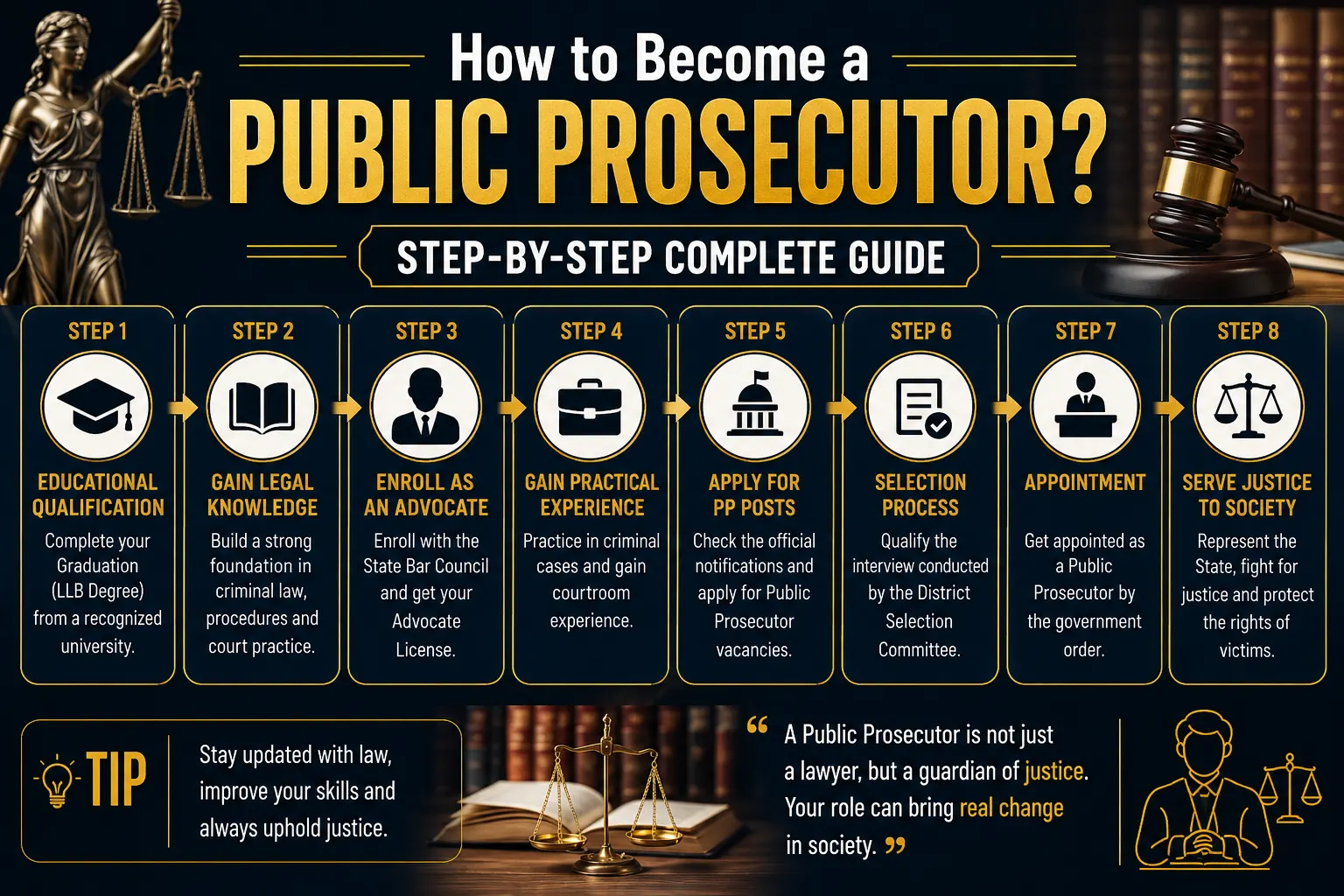
Process to Become a Public Prosecutor – Step by Step
Say you’re finishing 12th right now, or maybe halfway through a graduation degree already. Here’s roughly what the road looks like from wherever you’re standing.
Step 1: Complete the Right Law Degree
Recognised college. Solid reputation. Finish the LLB there. People underestimate how much this first step matters—it’s the base everything else stands on. A decent institute doesn’t just make you memorise sections of law; it actually teaches you to think under pressure, which is a completely different skill.
Step 2: Enrollment with the Bar Council of India
Degree in hand? Register with your state bar council next. Then comes the AIBE — All India Bar Examination. Clear it, and you get the Certificate of Practice. Without that piece of paper, you’re not legally allowed to practise in court. Period.
Step 3: Gain Practical Experience
This step doesn’t have a shortcut. Junior under a senior advocate or go solo at a district court if you’re confident enough. Either way, push toward criminal cases specifically — that’s the entire universe a prosecutor operates in, so might as well start building that muscle early. Knowledge, confidence, courtroom reflexes — they all come from actually being in the room, not from a textbook.
Step 4: Competitive Exam and Selection Process
Recruitment usually runs through the State Public Service Commission — RPSC, if you’re in Rajasthan — or directly via the high court. Three stages, generally:
- Written Exam: IPC, CrPC, Evidence Act, Constitution, General Knowledge. All fair game.
- Interview/Viva: Clear the written part, and next comes a face-to-face round testing your legal grasp, how clearly you speak, and whether you crack under a little pressure.
- Document Verification: Last stop. Every certificate and every eligibility document was checked line by line.
A few states also run assistant public prosecutor openings — a lighter experience bar, and yes, fresh graduates get a shot too.
One thing worth remembering: the degree alone won’t carry you through. Landmark judgements, recent legal changes, a working memory of IPC and CrPC and the Evidence Act — all of that needs to stay current in your head. Reading legal news daily sounds boring. It genuinely helps.
What Does the Public Prosecutor Exam Syllabus Cover?
Varies slightly by state, sure, but broadly it comes down to this:
| Subject | What It Covers |
| Indian Penal Code (IPC) | Crime definitions, punishments, legal provisions |
| Code of Criminal Procedure (CrPC) | Court procedure, arrest, bail, investigation rules |
| Indian Evidence Act | How evidence gets presented and accepted in court |
| Constitution of India | Fundamental rights, judiciary structure, basic constitutional law |
| General Knowledge / Current Affairs | Notable state and national events |
| Language Skills | Communicating clearly in Hindi and English, written and spoken |
Why Preparing at Rajasthali Law Institute Is Worth It
Rajasthali Law Institute, and places like it, don’t stop at handing out a degree. There’s real emphasis on courtroom practice, mock trials, and exam prep that’s actually built around what the exam tests. Faculty who’ve spent time in actual courtrooms — not just lecture halls — walk students through case studies, moot court sessions, and whatever’s changed recently in the law. For a career this competitive, that kind of grounding matters more than people initially realise.
What that translates to, practically:
- Faculty guidance rooted in real courtroom experience, not just theory.
- Confidence that builds gradually, through repeated moot court and mock trial reps.
- Study material that stays current, alongside prep aimed specifically at the exam pattern.
- Internships and networking — the kind of practical exposure that’s hard to get on your own.
Skills Needed to Become a Public Prosecutor
Degree done, exam cleared — think that’s it? Not really. A handful of personal traits end up mattering just as much:
- Strong Communication: Making your point in court, clearly, without stumbling.
- Deep Knowledge of Criminal Law: Actually knowing IPC, CrPC, and the Evidence Act — not just having read them once.
- Case Analysis and Research Skills: Reading facts and evidence carefully, catching what others miss.
- Confidence and Presence of Mind: Handling a curveball question mid-hearing without losing composure.
- Patience and Ethical Values: This job sits right next to justice itself, so integrity isn’t optional; it’s the whole point.
Salary and Career Growth
Starting salary tracks the state’s pay scale — usually somewhere in the ₹40,000 to ₹80,000 monthly range, and it climbs as experience builds up. It’s a government job, so DA, HRA, pension — all of that comes bundled in too.
Growth-wise, there’s an actual ladder: Public Prosecutor, then Senior Public Prosecutor, then District Government Counsel, and eventually Additional Public Prosecutor if things go well. Quite a few experienced prosecutors eventually sit for judiciary exams and end up as judges themselves. So no — not just a job. A whole career arc, with real room to climb.
FAQs – Common Questions About Public Prosecutors
Q1. What’s the minimum qualification needed to become a public prosecutor? LLB degree, plus enrolment with the State Bar Council. That’s the baseline.
Q2. Can a fresh LLB graduate directly become a public prosecutor? Usually not — some practice experience is expected first. Though Assistant Public Prosecutor roles are more open to freshers.
Q3. How does the selection process for a public prosecutor work? A written exam, then an interview, run by the State Public Service Commission or the High Court, depending on the state.
Q4. Can studying at Rajasthali Law Institute help you become a public prosecutor? Yes. A recognised degree from there, paired with the practical training they offer, sets candidates up fairly well for the exam.
Q5. What’s the difference between a public prosecutor and an advocate? Advocates work for private clients. Prosecutors work exclusively for the government and only on criminal cases.
Q6. How much does a public prosecutor earn? Roughly ₹40,000 to ₹80,000 a month starting out, rising with experience over time.
Conclusion
There’s something genuinely meaningful about this career — it’s respectable, secure, and it puts you in a position to actually deliver justice, not just talk about it. Right guidance, consistent practice, and solid preparation from somewhere like Rajasthali Law Institute – and the path opens up. Finish the LLB. Get real courtroom time in. Keep the legal knowledge sharp and keep it updated. Put the work into exam prep. The rest, more often than not, follows.