
Best BA LLB College in Didwana-Kuchaman
Picking a BA LLB college isn’t like picking a coaching center for a one-year exam. You’re signing up for five years—sometimes the better part of your early twenties—so the decision deserves more thought than just looking at whichever college has the flashiest hoarding on the main road.
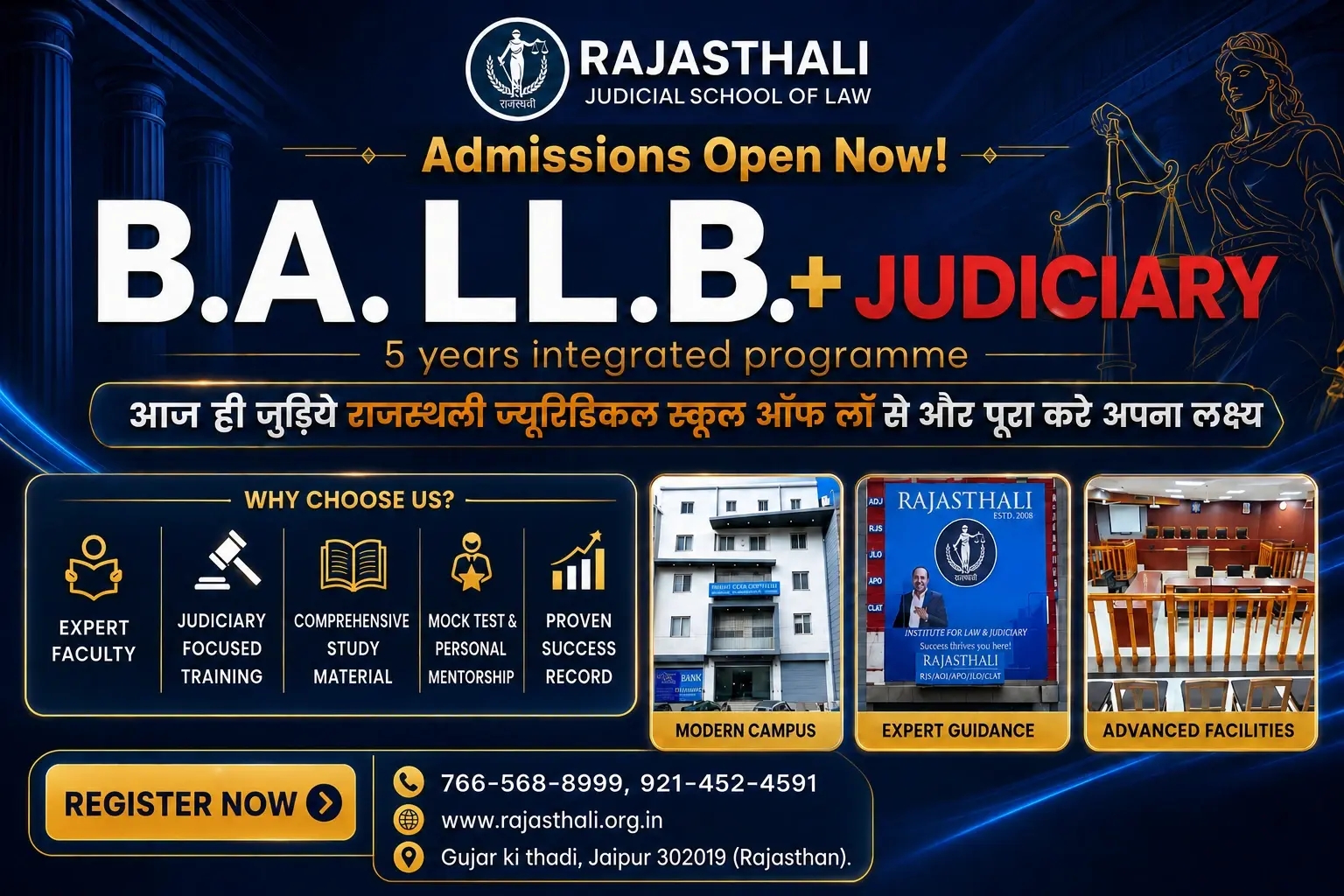
If you’re researching the best BA LLB college in Didwana-Kuchaman, Rajasthali Judicial School of Law (run under Rajasthali Law Institute) is a name worth adding to your shortlist. It’s built specifically around legal education, and for students who want a five-year integrated law program without having to relocate to a bigger city, that’s not a small thing.
Why the Choice of College Actually Matters This Much
A BA LLB degree isn’t just about clearing exams every semester. It shapes how you think, how you argue, and how comfortable you get with reading dense material and pulling out what actually matters. Five years is a long stretch to spend somewhere that isn’t taking that seriously.
Things students should be weighing before they commit anywhere:
- Whether the faculty actually has legal teaching experience, not just a law degree sitting unused
- How the college balances academics with moot courts, internships, and practical exposure
- Library access, case-law material, and whether the resources go beyond a few outdated textbooks
- Bar Council of India recognition—this one’s non-negotiable; always check it
- Batch size and how much individual attention students realistically get
- Campus environment, and whether it’s realistic for you to actually attend regularly
A good BA LLB college in Didwana-Kuchaman should be handling most of this without students having to chase it down themselves.
About Rajasthali Judicial School of Law
Rajasthali stays focused on legal education specifically, which matters more than people initially realize. A lot of colleges run law as one of several unrelated courses, and it shows in how much attention the department actually gets. An institute built around law from the ground up tends to bring more intent into how the program is structured.
A few things worth knowing about the institute directly:
| Detail | Information |
| Institute | Rajasthali Judicial School of Law (Rajasthali Law Institute) |
| Chairman | Mr. M.K. Singh |
| Batch Size | Limited to 60 seats, in line with Bar Council of India norms |
| Google Reviews | 4.7 out of 5, based on around 200 reviews |
| Study Material | Handwritten notes, PDF notes, class notes, topic-wise and subject-wise notes |
| Contact | +91 7665688999 |
| Website | www.rajasthali.org.in |
That said—and this is worth repeating for every institute, not just this one—go verify the current affiliation status, faculty details, and course structure directly with the college before applying. Admission brochures age fast, and what was true last year isn’t always true this year.
What a Five-Year BA LLB Program Actually Involves
The degree combines a regular BA—covering subjects like political science, economics, sociology, and history—with a full law curriculum layered on top. It’s a lot to cover in five years, honestly, which is exactly why the structure of the program matters so much.
The early semesters usually lean toward foundational subjects—legal English, political governance, legal and constitutional history of India, legal methods, and an introduction to torts—alongside general BA papers that ease students into legal thinking without throwing them in the deep end immediately.
The middle semesters start getting into the actual meat of law—constitutional law, family law, jurisprudence, public international law, company law, labor law, and criminal law. This is also where moot court participation usually starts becoming a real part of student life, not just an optional extracurricular.
The later semesters shift toward administrative law, property law, taxation principles, intellectual property, environmental and cyber law, and procedural subjects like the Criminal Procedure Code and Civil Procedure Code. The final stretch typically includes practical and clinical papers—drafting and pleading, mediation and arbitration, professional ethics, and a moot-court-cum-internship component that ties the theory back to real practice.
By this point, students should already have a rough sense of which area of law actually interests them, whether that’s litigation, corporate law, or something else entirely.
What to Look For in a BA LLB College
Recognized Affiliation
This should be step one, not step five. Confirm the college is affiliated with a recognized university and approved by the Bar Council of India. Skipping this check, or assuming it’s fine because “everyone says so,” has genuinely derailed students’ careers before.
Faculty With Real Legal Background
Professors who’ve actually practiced law or who stay engaged with how the field is evolving bring something to a classroom that pure textbook teaching can’t replicate. Ask around, or ask the college directly, about faculty backgrounds before assuming.
Moot Court and Practical Exposure
Law isn’t just theory, and colleges that treat mooting as optional are doing their students a disservice. Regular moot court practice, internship support, and exposure to actual legal proceedings matter more for eventual placement and confidence than another semester of pure lecture-based learning.
Library and Research Resources
Legal study leans heavily on case law and precedent. A college with a thin, outdated library is going to leave gaps that students end up filling with random internet searches—not ideal when precision actually matters.
Batch Size
A smaller, capped batch—Rajasthali, for instance, keeps its intake to 60 seats in line with Bar Council norms—tends to mean faculty can actually notice when a student’s struggling, rather than that student getting lost in a lecture hall of two hundred.
Campus Life and Support
Five years is long enough that the campus environment genuinely affects how well someone does. Support systems, approachable faculty, and a reasonable balance between academic pressure and everything else matter more than most prospectuses admit.
A Rough Look at What Studying Here Involves
| Semester Range | Focus |
| Semester 1-2 | Legal English, political governance, legal history, foundational BA subjects |
| Semester 3-6 | Constitutional law, family law, jurisprudence, company law, criminal law |
| Semester 7-8 | Administrative law, property law, taxation, IP, and cyber law |
| Semester 9-10 | Procedural law, evidence, drafting, moot court, internship |
Exact structure and subject sequencing can differ depending on university affiliation, so this is more of a general shape than a fixed timetable.
BA LLB Admission and Fees in Didwana-Kuchaman
Admission into a five-year BA LLB program usually runs through CLAT or a similar entrance test, sometimes combined with the college’s own eligibility criteria. Fees vary a fair bit depending on infrastructure, affiliation, and what’s included—study material, library access, moot court resources, and so on.
| Component | Details |
| Entrance Requirement | CLAT or equivalent varies by college. |
| Tuition Fees | Institute-specific—check current fee structure directly |
| Study Material | Handwritten and PDF notes are typically included. |
| Library and Resources | Usually included in tuition |
| Moot Court Fees | May be separate or bundled |
None of these numbers should be taken as fixed—always confirm directly with the admissions office, since fee structures get revised almost every academic year.
Life Beyond the Classroom
A BA LLB degree isn’t just lecture halls and exams. Debate societies, moot court teams, legal aid clinics, and guest lectures from practicing lawyers—these add up to more than most students expect going in. A college that actively runs these, rather than leaving them to student initiative alone, tends to produce more confident graduates by the time the final semester rolls around.
Internships deserve a special mention here. Real courtroom or law-firm exposure during the degree, even in small doses, teaches things no classroom really can. Colleges that help arrange or at least actively support internship placements are doing students a real favor.
Common Mistakes Students Make While Choosing a College
Picking based purely on proximity to home, without checking affiliation or faculty quality, tends to backfire later. Ignoring Bar Council recognition entirely—this one’s serious, since it affects whether the degree is even valid for practicing law. Assuming all law colleges teach roughly the same thing, which isn’t true; the gap between a genuinely engaged faculty and a disinterested one shows up fast once classes start. Underestimating how much moot court and practical work matter for eventual placements. And not actually visiting or thoroughly researching the campus before committing five years of life to it.
Why Choose Rajasthali Judicial School of Law for Your Legal Education?
Looking for the best BA LLB college in Didwana-Kuchaman? Then Rajasthali’s exclusive focus on legal education is worth considering. Rather than running law as a side offering among several unrelated courses, the institute’s structure is built around it from the start—a capped batch size, structured semester-wise study material, and a curriculum that moves from foundational subjects toward practical, clinical papers by the final years.
Before applying anywhere, though, it’s worth checking directly with the institute on:
- Current affiliation and recognition status
- Faculty qualifications and experience
- Moot court and practical training opportunities
- Library and academic resources
- Fee structure and available facilities
Frequently Asked Questions
Which is the best BA LLB college in Didwana-Kuchaman?
There is no single answer here—it really depends on what matters most to you personally, whether it be faculty, exposure, cost, or closeness to home. For students who want a focused legal education with a small batch size, Rajasthali Judicial School of Law is a good option.
What is the duration of a BA LLB course?
It is a five-year integrated program that combines a BA degree with a full law curriculum, which is usually spread over ten semesters.
Is CLAT required for BA LLB admission?
Many colleges take the CLAT or a similar entrance exam for admission. Eligibility criteria may vary from college to college. Best to check with the college itself.
What career options open up after BA LLB?
Typical routes include litigation, company law, judiciary, legal consultancy, and further specialization through an LLM, but what works for any student depends on their own interests and strengths.”
How important is Bar Council of India recognition?
Extremely important.
Without it, practicing law after graduation isn’t possible, so this should be verified before applying anywhere, not after.