
Best Law Courses Eligibility After 12th: Complete Guide
Choosing what to study after Class 12 is a big decision, and Law has steadily become one of the more popular routes for Indian students. It offers a career path that’s respected, varied, and genuinely rewarding if you stick with it.
Students from arts, commerce, and science backgrounds can all study law after Class 12 — but before applying anywhere, it’s worth understanding the different courses and what each expects of you.
India offers several integrated law programmes, and what makes them interesting is that they combine legal education with subjects from arts, business, commerce, science, or even technology, depending on which one you choose.
This guide walks through law course eligibility after 12th in detail — the entrance exams, specialisations, career paths, the skills that actually help, and how the admission process works in practice.
Why Choose Law as a Career After 12th?
Law isn’t just about courtrooms anymore. Trained legal professionals today show up across pretty much every major industry.
Law graduates build careers in corporations, government departments, law firms, courts, banks, and universities — and increasingly in technology companies, media houses, and nonprofits too.
A legal education also builds skills that are useful well beyond the courtroom: communication, critical thinking, research, negotiation, and problem-solving are all things you pick up along the way.
On top of that, law gives people a genuine chance to protect rights and support access to justice, which is part of why it appeals to students who want work that feels meaningful rather than just a pay cheque.
Major Benefits of Studying Law
Here’s what studying law tends to offer, academically and professionally:
- A wide range of career choices
- Strong professional recognition
- Opportunities in government and public sector roles
- Communication and research skills that transfer to almost any job
- The option of independent legal practice
- A path into the judiciary or civil services
- Specialisations in newer, emerging legal fields
- Solid potential for long-term career growth
That said, legal education isn’t something you coast through — it demands consistent reading and real interest in political, economic, and legal developments. If current affairs bore you, law school will feel like a slog.
Law Courses After 12th: The Basics
Right after Class 12, most students enter law through a five-year integrated programme that combines a bachelor’s degree with an LLB.
The popular options here are BA LLB, BBA LLB, BCom LLB, BSc LLB, and BTech LLB.
The Bar Council of India recognises both this five-year route straight after Class 12 and the more traditional three-year LLB that comes after a separate bachelor’s degree. Either way, it’s worth confirming the institution and programme you’re considering is actually approved.
There are also shorter diploma and certificate courses in legal subjects, but it’s worth knowing upfront that these alone won’t qualify you to practise as an advocate.
General Eligibility for Law Courses After 12th
Exact requirements shift a bit between colleges, universities, and entrance exams, but a few general conditions apply across most integrated law programmes.
Educational Qualification
You need to have passed Class 12 (or an equivalent exam) from a recognised board.
Students from arts, commerce, and science can all generally apply — studying arts in school isn’t a prerequisite for pursuing law.
A few specialised courses do come with subject requirements, though. For instance, BTech LLB programmes generally require Physics, Chemistry and Mathematics in Class 12.
Qualifying Marks (Minimum)
The number of points you need to score depends completely on the institution and the entrance exam you are going for.
The minimum marks required for admission to undergraduate programmes through CLAT 2027 are 45 per cent for general category applicants and 40 per cent for SC, ST and PwD candidates.
Other universities set their own percentage cutoffs, so it’s worth reading each admission notice carefully rather than assuming the same rules apply everywhere.
Age Limit
Most major law entrance exams these days don’t enforce an age limit — CLAT 2027, for example, has none for undergraduate candidates.
That said, individual institutions sometimes have their own rules on this, so it’s worth confirming directly before you get too far into an application.
If you are still appearing for class 12th
If you are currently appearing for your Class 12 exams, you can generally still apply on a provisional basis. The catch is that you will have to provide proof of passing before the deadline for admission.
Miss that step and you could be refused admission – so it’s a good idea to get your certificates and documents organised early rather than scramble at the last minute.
Best Law Courses After 12th
There are law courses that you can take after 12th. You should compare the courses. See which one is the best for you. Different people like things, so it is a good idea to look at the subjects you will study, the specialisations you can choose, and the kind of job you can get after completing the course.
1. BA LLB: Bachelor of Arts and Bachelor of Laws
BA LLB is a popular law course that you can take after 12th. This course teaches you about arts and social science and about law.
The BA LLB course is for five years. You will study law and other subjects like science, sociology, economics, history and public administration.
Main Subjects, in BA LLB
The BA LLB course has subjects, including:
- Constitutional Law
- Criminal Law
- Law of Contracts
- Family Law
- Property Law
- Administrative Law
- Environmental Law
- Jurisprudence
- Political Science
- Sociology
- Economics
- Legal. Research
The subjects you study may be a little different depending on the university you go to.
BA LLB Eligibility After 12th
To do a BA LLB, you need to have passed 12th from a school. Any student can apply for a BA LLB; it does not matter what subjects you studied in school.
The marks you need to get into BA LLB depend on the university. How they choose students. Some universities choose students based on their marks in 12th. Some have an entrance exam.
Who Should Choose BA LLB?
This one suits students drawn to litigation, public administration, the judiciary, civil services, or social justice work.
The humanities grounding also helps you understand society, governance, and public policy more deeply — knowledge that turns out to be genuinely useful across many areas of legal practice.
Career Options After BA LLB
Graduates from this programme often go on to become:
- Advocates
- Legal advisers
- Judicial services aspirants
- Prosecutors
- Legal researchers
- Policy analysts
- Civil services aspirants
Human rights professionals
2. BBA LLB: Bachelor of Business Administration and Bachelor of Laws
If you have an interest in both business and law, BBA LLB can be a good option. This is a five-year integrated course of management studies and legal education. Alongside subjects such as marketing and human resource management, you will also study important areas of law such as contract law, company law and business law.
- Subjects You’ll Study: Business Management, Marketing Management, Financial Management, HR Management, Business Communication, Corporate Law, Company Law, Contract Law, Competition Law, Banking Law, and Intellectual Property Law.
- Eligibility: You should have cleared Class 12 from any stream — Arts, Commerce, or Science. Colleges have their own percentage cut offs and many will also require you to take an entrance test.
Is this course right for you?
This programme may be just the right fit for you if you’re looking to get into business management and learn about the legal side of business.
- Career Opportunities: The programme provides a wide range of career opportunities in the legal field, including corporate lawyer, legal consultant, compliance officer, contract manager, legal analyst, company secretary and specialist in banking law.
3. BCom LLB: Bachelor of Commerce and Bachelor of Laws
This choice suits people who like numbers and law together — think taxation, banking, and finance. It’s a five-year programme, and it’s one of the more practical combinations for a career in commercial law.
- Subjects: Financial Accounting, Business Economics, Corporate Accounting, Taxation, Auditing, Business Statistics, Company Law, Banking Law, Insurance Law, Commercial Law, Securities Law, and Insolvency Law.
- Eligibility: A Class 12 pass is required, and any stream will do. However, a background in commerce makes the accounting sections easier. Different colleges have varying marks and entrance requirements.
- Who fits here: anyone interested in tax, banking, auditing, or company regulation as a career.
- Career paths: tax lawyer, corporate legal adviser, banking law consultant, compliance executive, financial regulation analyst, commercial lawyer, legal auditor, insolvency professional.
4. BSc LLB: Bachelor of Science and Bachelor of Laws
Not many know this exists, but BSc LLB combines a science degree with law — think environmental science, biotech, chemistry, or forensics based on what the university offers. It is also a five-year course.
- Subjects: Environmental Science, Biotechnology, Forensic Science, Chemistry, Cyber Law, IP Law, Environmental Law, Medical Law, Evidence Law, Criminal Law, and Technology Law.
- Requirements: Some colleges prefer students who have taken science in class 12, which includes physics, chemistry, biology or mathematics. Since every college can have different requirements, you should check the eligibility norms before applying.
Good Fit: If you are interested in science, technology, health care, forensic studies, or environmental issues and want to know how the law works in these areas, this course may be for you. - Career Options: When you finish this course, you can look for jobs like a lawyer. You can also be a legal consultant or a patent professional. Some people become technology law advisers. Others work as healthcare consultants or cyber law professionals. You can even be a researcher or a compliance officer in companies that deal with science.
5. BTech LLB: Bachelor of Technology & Bachelor of Laws
“It’s not a common option, not offered at every college.” It is a marriage of engineering and of law. If you like working where tech meets rules, such as patents, online safety or data privacy, it’s perfect.
- What you’ll learn: computer science, basic engineering, online safety, data privacy laws, internet laws, patent laws, ownership rights (IP), tech contracts, AI rules, digital proof, and phone network laws.
- Who is eligible to apply: Generally, you need to have studied physics, chemistry and maths in Class 12 and meet the minimum marks that the college asks for. Some places also look at your engineering or entrance exam scores, so it’s smart to check how each college does their admissions.
- Who is this for: Students who love engineering or AI but also want to be a lawyer or work with laws. Make sure the course is reputable and approved before you jump in.
- Jobs you could land: tech lawyer, internet safety legal guide, patent specialist, data privacy worker, tech contract manager, digital rules expert, ownership rights advisor, or tech company legal assistant.
6. BLS LLB: Bachelor of Legal Studies and Bachelor of Laws
This is another 5-year course combining two degrees. But only a few colleges offer it. The first couple of years you learn the basics of law and social studies. As you advance, the classes get more specialised and hands-on.
- Who can apply: You just need to clear Class 12 from any stream (arts, science or commerce). But the marks you need and the entrance tests will be different for each university.
- What this means: Fighting cases in court Working for big companies Government jobs: studying laws deeply or becoming a judge. As usual, ensure that the college is officially recognised before you pay any fees.
Diploma in Law After 12th
If you want to get a quick insight into a particular type of law without doing a full degree, then a diploma is a good option. You can pick topics like internet law, company law, crime studies, human rights, worker laws, ownership rights, tax laws, or customer rights.
The rules to join are different everywhere. Some diplomas take you right after Class 12, but others might want you to have a college degree or some law knowledge first. It’s best to check the rules for each course yourself.
Just remember: a diploma does not make you a real lawyer who can fight in court. You still need a full LLB degree for that. Think of a diploma as an extra skill, not a replacement for a main degree.
Certificate Law Courses After 12th
These are even shorter than diplomas.
You can get certificates in internet law
human rights, customer law
ownership rights
writing legal papers
world law
business rules or media law
They’re a good way to pick up something quickly but they don’t carry as much weight as a full LLB degree.
Law Entrance Exams After 12th
Most of the top law colleges will make you take a test to get in, so it’s a good idea to know about these tests early on.
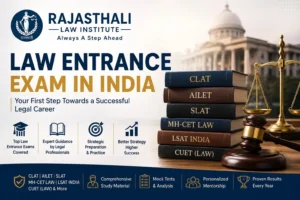
- CLAT: This is the biggest test, and most of the top government law schools use it. It checks your reading, how well you think, and what you know about the daily news. The test for 2027 is planned for December 6, 2026 (but this might change). You fill out the form online, but you have to go to a centre to take the actual test.
- AILET: The top law school in Delhi holds this test on its own. Don’t think your CLAT form will work for this one—it won’t. Keep checking the AILET website to stay updated.
- Other ways in: There are also state tests, tests for specific universities, tests for private colleges, or ways to get in based on your 12th marks. Rules change every year, so be sure to check the official college websites.
Preparing for these exams
Check the syllabus and test pattern very carefully. Observe the topics, nature of questions, marks distribution and time given. If you skip this, you might waste time studying the wrong things.
Make it a habit to read every day. Pick a good newspaper, opinion pieces, or anything that teaches you something. This builds your word power and general knowledge naturally over time. Practice thinking and logic questions often, especially the long reading passages. Learn how to tell the difference between a real fact and just someone’s opinion.
Practice tests are awesome, but only if you actually go back and review what you missed. Just taking the tests and not correcting your mistakes will not make you improve. Review your brief notes of new words, daily news, math formulas or whatever you find difficult. Make sure you check them regularly.
What It Takes to Study Law
- Good speaking and writing: You’ll need to be able to explain tough topics clearly, both aloud and on paper.
- Locating information: Practice reading old court cases, rulebooks and articles You also have to learn what information is trustworthy and what is not.
- Clarity of thought: Most law problems do not have a clear answer. You have to look at all sides and use the rules carefully.
- Managing your time: You will have to juggle your classes, lots of reading, work experience, projects, and tests all at the same time. Having a daily routine is a must.
- Noticing the little things: Missing a tiny fact can completely change a case. You can’t afford to read things carelessly.
- Truthfulness: Part of the job is keeping secrets and working with private details. You are required to be honest and behave as a professional at all times.
Career Opportunities After Law Courses
- Litigation (Fighting in court): If you register properly, then you can go to court and argue cases. Most people learn from a senior lawyer first.
- Corporate law: Supporting big companies with contracts, acquisitions, negotiations and compliance.**How to be a judge:** You can become a judge in the local courts by passing the state exams. Rules vary from state to state, so always check for the latest updates.
- Government jobs: You may also work for rule-making groups or government offices. Usually you have to pass a special test to get these jobs.
- Research and planning of law: You could work with colleges, courts or clever groups of people to study laws and how they affect society.
There are also lots of fun new jobs popping up today. You could be an expert in protecting data, internet laws, AI rules, ownership rights, nature laws, sports rules, movie and TV laws, hospital rules, or fair business laws.
Tips to Choose the Best Law Course After 12th
Students should not take a course simply because it is popular. Your interests, strengths and career goals will dictate the right choice.
Find Your Career Interest
- Want to be a litigator, work in public policy, the judiciary or civil services? Go for BA LLB
- BBA LLB in corporate law, management and business consulting.
- A BCom LLB in taxation, banking, finance and commercial laws is the way to go.
- If you want to pursue scientific, forensic, medical or environmental legal fields, then BSc LLB is the right choice for you.
- Think BTech LLB for tech, patents, cybersecurity and digital law.
Frequently Asked Questions (FAQs)
- Can Science Students Pursue Law?
Yes, science students can apply for most integrated law programmes.
They can also consider BSc LLB or BTech LLB when eligible.
- Can Commerce Students Pursue BA LLB?
Yes, commerce students can generally pursue BA LLB.
Most integrated law programmes accept applicants from any recognised Class 12 stream.
- What Is the Duration of Law After 12th?
An integrated law degree after Class 12 generally takes five years.
The three-year LLB programme is designed for students who have already completed graduation.
Conclusion
The legal field truly welcomes applicants with various educational backgrounds.
If the field of courts, the judicial system, public law and governmental services interests you, then BA LLB will be a good choice. If business and corporate law attracts your attention, go for BBA LLB.
BCom LLB should be considered for those interested in taxation, financial and banking law. The combination of science and law is possible in BSc LLB.
BTech LLB, in turn, can help get access to technology-related law issues, patents, cybersecurity, data protection, etc., although there are a number of differences between the BTech LLB programmes offered by various colleges.
Prior to making your choice, consider carefully what is offered by a specific course, whether the programme is accredited or not, what exams are required for admission, its cost, facilities and employment opportunities after graduation.
Above all else, make sure that the program you choose is legitimate one.